 Tres Rios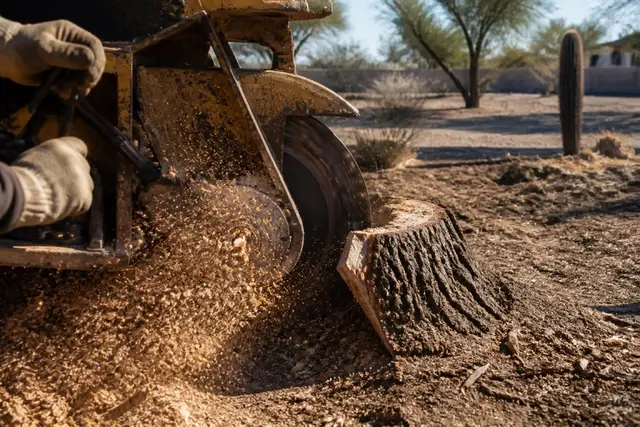
Tres Rios Land Clearing connects Avondale property owners with a local land clearing contractor for stump grinding in Avondale and the surrounding West Valley communities.
Stump grinding is the small-ticket workhorse of the clearing trade: a carbide wheel chews the stump into chips from above grade to eight or twelve inches below it, the hole gets backfilled with the grindings, and the tripping hazard, termite buffet, or mower obstacle is gone by lunch. In the southwest Valley the usual customers are mesquite stumps left by storm losses, palm stumps from a landscaping change of heart, and old eucalyptus from the farm-era windbreaks that once lined every irrigated field out here.
Desert stumps punish shortcuts. Mesquite left as a flush-cut stump does not rot on any human timescale in this climate — it resprouts instead, and the sucker growth off an unground crown is thornier and denser than the tree ever was. Palms do not resprout, but their fibrous root mass holds a surprising amount of ground and dulls cheap equipment fast. Grinding to proper depth, through the crown and the major root flare, is what actually closes the account.
Pricing runs on inches, not hours. Around the Phoenix metro a single stump typically costs between $115 and $205 depending on diameter, with per-inch rates dropping fast when several stumps get done in one visit — the mobilization is the expensive part. If a clearing or removal job is already on the books, adding the stumps is nearly always cheaper than a separate call later.
Why desert stumps do not just rot away
In wetter climates a stump is a ten-year composting project. Sonoran ground offers neither the moisture nor the fungal activity to do that work — the Arizona Cooperative Extension notes how slowly woody material breaks down in low-desert soils, and anyone who has kicked a decade-old mesquite stump knows it kicks back. Meanwhile the stump interferes with everything: irrigation trenching, wall footings, and every pass of a mower or grader that has to steer around it.
The termite angle is real but often misread. Subterranean termites are native and everywhere in Maricopa County; a stump near the house is not what brings them to the neighborhood, but it is a standing food source and a colony staging point closer to your slab than anyone should be comfortable with. Grinding removes the wood mass; the backfilled chips dry out and disperse instead of feeding anything.
Grinding depth, roots, and what happens after
A normal grind runs eight-to-twelve inches under the surface — plenty for grass or gravel over the spot, and deep enough to wreck a mesquite root crown so no suckers follow. Building over the spot is a different spec: footings want the major lateral roots chased out too, which is quoted as excavation rather than grinding. Saying what the spot's future is gets you the right depth the first time.
Expect the backfilled grindings to settle for a season as air pockets close — topping the dip with a bag of fill is normal homeowner maintenance. In monsoon season, settle happens faster; the first good soak documented by the Phoenix NWS each summer usually finishes the compaction that dry weeks would stretch across months. Nothing about it signals a problem — it is chips becoming soil.
Good to know
How much does stump grinding cost in the Avondale area?
Single stumps in the Phoenix metro generally run $115–$205, scaled by diameter measured at the widest point of the flare. Minimum service calls exist because the machine has to travel, so batching stumps — yours, or yours plus a neighbor's — cuts the per-stump price sharply.
How deep do you grind a stump?
The standard cut runs roughly eight inches under grade, deeper on mesquite — enough for replanting, gravel, and regrowth prevention alike. If a footing, wall, or pool wall is going where the stump was, say so — that calls for chasing roots with an excavator, priced as a small dig instead of a grind.
Will a ground mesquite stump grow back?
Not when the grind goes through the root crown, which is the buried structure the resprouts come from. A flush chainsaw cut will regrow almost every time; a proper below-grade grind ends it. Volunteer seedlings from dropped pods are a separate, minor matter for a hoe.
Can you grind stumps close to walls, pipes, and irrigation lines?
Yes, with care and information. The wheel can work within a few inches of block walls; the real risk is what is buried, so shallow irrigation and low-voltage lines get located first. Utility locates are requested for anything near meters or easements before grinding starts.
What do I do with the pile of grindings?
You can let the mound settle back into its own hole, rake the chips out as rough cover on bare ground, or add haul-off to the ticket. Fresh chips briefly draw nitrogen as they decompose, so mixing large volumes into planting beds is the one use to skip.