 Tres Rios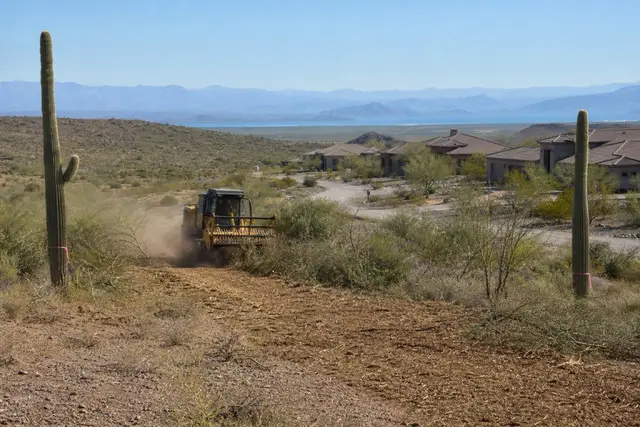
Tres Rios Land Clearing connects Peoria property owners with a local land clearing contractor for clearing, mulching, and brush work across the Peoria area.
Peoria runs from its old farm-town core on Grand Avenue all the way north into the Sonoran uplands around Lake Pleasant — 190,985 residents at the 2020 Census, spread across one of the largest city footprints in the Valley. For clearing work, the city splits into two markets: established-neighborhood jobs in the south, and the custom-homesite desert of the north, where acre-plus lots get opened for construction in some of the metro's best remaining saguaro country.
Northern Peoria homesite work is the flagship job type. These lots sell precisely because of their desert — mature saguaros, ironwood, foothill palo verde — so clearing is surgical: the building envelope, drive corridor, and defensible space opened; specimen natives flagged and preserved or, where the state permits it, salvaged for relocation; and the balance of the lot left as the landscape the owner paid for. Arizona's native plant law is not a footnote on these parcels; it is the schedule's first entry.
Down in older Peoria, the work looks like any mature West Valley grid: overgrown lots, aging landscape trees, alley and fence-line cutbacks, and the occasional deep-lot reclamation on the blocks that date to the town's farming decades. Different machines, different pace — same standard of leaving the property finished rather than just emptier.
Building in saguaro country without wrecking it
North Peoria parcels regularly carry the highest density of protected natives of any residential ground in the metro, and the law is built for exactly this situation: landowner notification to the state before protected plants are destroyed on qualifying land, salvage assessment for what can be moved, and — the part this operation adds by policy — saguaros treated as permanent site features that envelopes bend around. The extension service's plain-English summary of the statute is required reading before anyone draws a building footprint out here.
Done well, the result is the north-Valley look that holds value: a home sitting in intact desert rather than on a scraped pad with three replanted cacti. The craft is in the sequencing — envelope staked, keepers flagged, mulcher working inside the lines, and the transition edges feathered so the cleared area reads as intentional space rather than a wound in the vegetation.
The Agua Fria and Lake Pleasant edges
Peoria's western boundary rides the Agua Fria — usually dry below the New Waddell Dam that holds Lake Pleasant, but a genuine river corridor with the vegetation dynamics that implies: cottonwood-willow remnants worth keeping, tamarisk worth removing, and flood-channel rules worth checking before bank work. Parcels along the corridor inherit both the amenity and the maintenance duty.
The north's upland washes behave like the mountain-front drainages they are, running fast and gravelly off the Hieroglyphic foothills in monsoon cells tracked by the Phoenix forecast office. Homesite plans that respect wash corridors — vegetated banks, squared crossings, no envelope creep into the flow path — spend less on drainage engineering and nothing on flood repair, which is the cheapest kind of clearing decision there is.
Further reading
Good to know
What does homesite clearing cost in north Peoria?
Envelope-and-driveway packages on acre-class desert lots typically run low-to-mid four figures, scaling with brush density and how much surgical preservation the lot demands. The native-plant survey and any state notification lead time are built into the schedule, not discovered during it.
Can the saguaros on my lot stay through construction?
Yes, and they should — they are protected, valuable, and the reason the lot looks like it does. They get flagged with generous working radius, the envelope is planned around them, and machine operators treat the flags as walls. Relocation, where truly necessary, is a state-permitted specialist job arranged separately.
Do you do selective thinning rather than full clearing?
Constantly — it is the signature north-Valley scope. Defensible space, view corridors, and usable ground opened while the specimen desert stays. The walk-through with flagging tape is where the plan gets made, plant by plant where it matters.
What about clearing an older Peoria residential lot?
South-side jobs — overgrown yards, failing landscape trees, deep-lot cleanups — price like mature-neighborhood work anywhere in the Valley: several hundred dollars for light scope, low four figures with tree removals and heavy hauling. Compact access is planned at the quote.
Are wash areas on my parcel buildable if cleared?
Mapped wash corridors are flood infrastructure, not spare lot area — filling or building in them invites damage and regulatory trouble. The clearing plan keeps banks vegetated and crossings engineered; the county's floodplain mapping settles what any given channel is.