 Tres Rios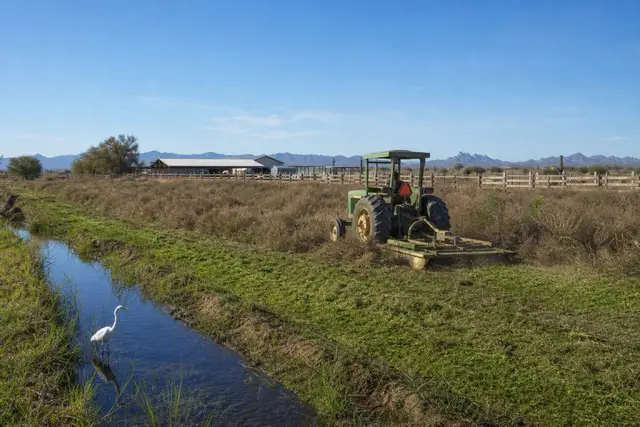
Tres Rios Land Clearing connects Avondale property owners with a local land clearing contractor for pasture & acreage reclamation in Avondale and the surrounding West Valley communities.
The land around Avondale grew alfalfa and cotton for a century before it grew rooftops, and thousands of acres of that old flood-irrigated ground still sit in private hands — horse setups in Laveen, hay fields near Liberty, and family parcels that stopped being farmed a decade ago and got claimed by tumbleweed, Bermuda gone feral, and volunteer mesquite. Reclamation is the project that turns that tangle back into ground you can irrigate, graze, or mow.
The sequence matters more than the machinery. First pass takes the standing biomass — brush hog for the weed mat, mulcher or grapple for woody regrowth — because nothing else can be judged until the ground is visible. Then the infrastructure gets its verdict: concrete irrigation ditches probed and cleaned or written off, borders and checks re-established where flood irrigation will run again, gopher damage mapped. Last comes the finish the use demands: disked and floated for planting, dragged smooth for turnout, or simply left mowed and maintainable.
Mesquite regrowth is the recurring villain. Ten fallow years puts ten thousand seedlings on an old field, and every one mowed flush comes back from the crown. Reclamation quotes here distinguish honestly between mowing (cheap, annual) and grubbing (dearer, durable) — the right answer is usually grubbing the established regrowth once, then holding the ground with an inexpensive yearly mow before the seed bank can rebuild its army.
Reading an old flood-irrigated field before you spend
Legacy Salt River Valley fields were engineered: laser-leveled borders, concrete-lined head ditches, and turnout gates tuned to move a sheet of water evenly to the tail. That engineering survives neglect surprisingly well — which is why the walk-through starts at the head gate, not the weeds. If the ditch runs and the grade still carries water, reclamation is mostly vegetation work and the parcel keeps its irrigated value; the UA Cooperative Extension, which has advised Valley irrigators for a century, remains the best free resource on bringing small-acreage irrigation back into service.
If the grade is gone — settled tail ends, gopher-tunneled borders, a decade of wind-drifted soil — then honest reclamation includes earthwork, and the quote should say so plainly rather than mowing the weeds and calling the field restored. Water delivery questions on district-served parcels get settled with the district before machines are scheduled, since a field you cannot get water to is just a very flat lot.
What reclaimed ground is worth in the southwest Valley
Irrigated horse acreage within commuting distance of Phoenix is scarce and getting scarcer — every year another section of legacy farmland west of the three-rivers confluence converts to rooftops, and what remains carries a premium precisely because it can grow feed and carry animals. A parcel under tumbleweed shows none of that value; the same parcel mowed, ditched, and watered shows all of it, whether the goal is use or sale.
There is also a straightforward carrying-cost argument. Fallow ground in Maricopa County generates weed complaints, harbors the tumbleweed crop that loads your fences and your neighbors', and burns readily in June. Maintained ground does none of those things, and the maintenance mow that keeps it that way is among the cheapest recurring services in the clearing trade — the expensive step is only ever the first one, and it only has to be paid once if the ground is held afterward.
Further reading
Good to know
What does it cost to reclaim a fallow field?
Mowing a weed-mat field runs cheap per acre; grubbing established mesquite regrowth and rehabilitating ditches is a genuine project priced from a walk of the actual ground. Most small-acreage reclamations in the metro land in the low-to-mid four figures. The quote separates one-time restoration from the annual hold-it mow.
Can my old irrigation ditches be saved?
Concrete-lined ditches usually survive neglect better than the field around them — silt and root intrusion at the joints are the typical failures, both fixable. The walk-through tests the run before quoting; a ditch that still carries water changes the whole economics of the parcel.
Should mesquite regrowth be mowed or grubbed out?
Grubbed, if you want it gone — mesquite regrows from the root crown, so mowing is a subscription, not a solution. The cost-effective pattern is one grubbing pass on the established regrowth, then cheap annual mowing to catch seedlings before they harden off.
What stops a reclaimed field from reverting to weeds?
Use it or mow it. Ground that gets grazed, cropped, or mowed twice a year holds; ground left alone starts the cycle again with the next wet winter. A standing seasonal mow arrangement costs a small fraction of re-reclamation and is the single best predictor of a parcel staying clean.
Do you work occupied horse properties?
Yes — with the animals' routine planned around, not ignored. Work sequences one turnout at a time, gates stay closed behind machines, magnet sweeps follow any work near old fence lines, and anything that came out of the ground leaves the property the same day it is pulled.