 Tres Rios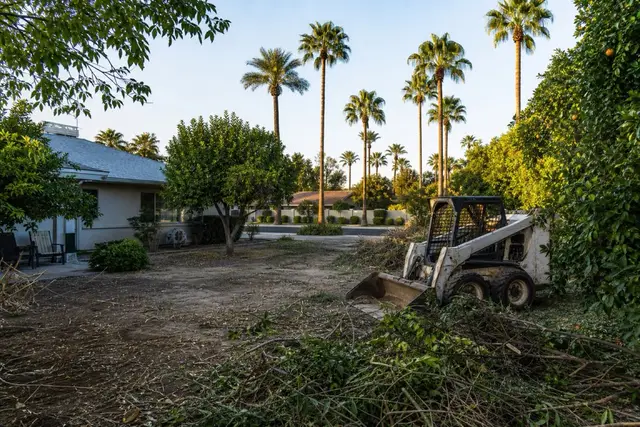
Tres Rios Land Clearing connects Litchfield Park property owners with a local land clearing contractor for clearing, mulching, and brush work across the Litchfield Park area.
Litchfield Park is the West Valley's original planned community — laid out around the ranches that grew long-staple cotton for the Goodyear Tire & Rubber Company, and now a small city of 6,847 residents (2020 Census) whose older neighborhoods carry the deep lots, mature date palms, and decades-old plantings that the rest of the metro's newer subdivisions lack. Clearing work here is less about raw desert and more about vegetation that has outgrown its welcome.
The standard call list: oleander hedges that became oleander walls, thirty feet tall and dying in patches; remnant citrus rows from the community's grove decades, half-alive and dropping fruit nobody picks; overgrown back acres behind homes on the original large parcels; and the occasional full clean-out where a long-held property changes hands and forty years of planting decisions get rationalized in a week. Machines are sized to the work — compact equipment through gates, full-size only where the lot allows.
Finesse is the differentiator in a place this established. Work happens between mature trees that are staying, over irrigation systems that are live, and next to neighbors close enough to care. Clean staging, dust courtesy, surgical removal of exactly what was agreed — the quote spells out what leaves and what stays, and the walk-through with flagging tape settles it before the first cut.
Oleander, citrus, and the vegetation of a planned town
Oleander earns special mention because Litchfield Park has miles of it. As a maintained hedge it is a fine screen; neglected, it becomes a dense, flammable mass of deadwood at its core, and every part of the plant is toxic, which makes casual disposal a bad idea. Removal that lasts takes the root ball, not just the canopy — the plant regrows enthusiastically from a stump — and disposal goes to facilities, never to a burn pile or a livestock property. The UA Cooperative Extension covers both the toxicity and the removal question in its desert-landscape guidance.
Old citrus is the sentimental half of the ledger. A producing row is worth keeping and pruning; a half-dead one hosts pests and drops litter year-round. Owners often split the difference — keep the best trees along the fence, grub the failing ones — and the clearing scope prices each tree honestly rather than selling a clean sweep the yard does not need.
Working inside a city with standards
Litchfield Park maintains the tidy-streets character it was planned for, and the city's codes reflect it — from property-maintenance expectations that make an overgrown lot a compliance letter waiting to happen, to right-of-way rules governing what can be staged where during work. A contractor who works the city regularly plans loading, traffic, and debris flow to keep the job invisible to everyone but the property owner.
Timing courtesies matter too: early starts beat the heat but respect the neighbors, and debris does not sit at the curb over a weekend. For larger clean-outs the practical pattern is one concentrated day with the right machine rather than a week of small equipment — less disruption, less dust exposure, and a lower bill than dragging the job out, particularly in the summer months when the heat advisories compress working hours.
Good to know
Can you remove a giant oleander hedge completely?
Yes — canopy cut, root balls grubbed, and all material hauled for proper disposal, since oleander is toxic and should never be burned or left where animals graze. Expect regrowth attempts if any root mass stays, which is why extraction is the version worth paying for.
What does a full backyard clean-out cost in Litchfield Park?
Deep-lot clean-outs typically run low-to-mid four figures depending on volume, haul distance, and access — a gated backyard that only fits compact equipment takes longer than an open side yard. The itemized quote splits removal, hauling, and any stump work.
Can you take out some citrus trees but keep others?
Selective removal is the normal request here. Keepers get flagged, failing trees get grubbed with roots so they cannot sucker back, and irrigation lines to the survivors are located and protected before digging starts.
Will the work damage my irrigation system?
Live systems get mapped first — valves, lines, and drip runs located and flagged. Grubbing near active lines is done with the excavator working away from them, and any nicked line is repaired before the crew leaves rather than discovered on your next watering day.
Do I need city permission to clear my own yard?
Routine vegetation removal on private property does not need a city permit, though right-of-way staging and roll-off placement can. The contractor handles those logistics; your part is deciding what stays.