 Tres Rios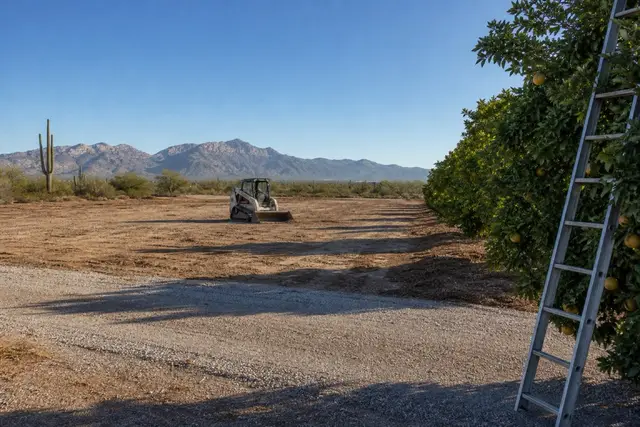
Tres Rios Land Clearing connects Waddell property owners with a local land clearing contractor for clearing, mulching, and brush work across the Waddell area.
Waddell is the West Valley's large-lot holdout — an unincorporated community platted in 1935 and named for the financier behind the Lake Pleasant dam, where acre-plus homesites sit among the last working citrus in the metro, and the White Tank Mountains fill the western horizon. Clearing here serves the community's two land types at once: grove-legacy parcels with old citrus rows and irrigation history, and native desert lots on the mountain side of the community.
Grove-parcel work has its own texture. Old citrus stumps hold the ground with dense root plates and have to be grubbed, not ground, when a building site goes where trees stood; abandoned drip and flood infrastructure threads the soil; and many owners keep a producing row along a fence line while clearing the rest — a split-the-orchard spec that takes flagging tape and care rather than a blanket pass. Volunteer brush moves into any grove that loses its water, so lapsed parcels usually need both jobs at once.
On the desert side, standard Sonoran rules apply at Waddell's larger scale: creosote and bursage cleared or thinned by plan, washes off the White Tanks treated with respect for the water they carry a few days a year, and protected natives — saguaros above all — flagged, preserved, and worked around. Big lots reward good sequencing, and the walk-through sets it before iron arrives.
Clearing where the groves are going, gone, or staying
A citrus parcel's clearing plan starts with an honest census of the trees: producing and keepable, alive but failing, or long dead with a woodpecker tenancy. Keepers get their irrigation verified and their root zones protected during adjacent work; the rest come out with root plates whole, because half-removed citrus roots are exactly the soft-spot generator a future pad does not want. The UA Cooperative Extension — which shepherded this area's citrus era in the first place — publishes the region's best guidance on both keeping and retiring old trees.
Water infrastructure is the second inventory: grove parcels carry decades of pipe, valves, and ditch, some of it still connected to something. Locating and capping before grubbing prevents both flooded holes and dead lines to trees you meant to keep — a half-day of care that regularly saves the whole job's margin.
Desert lots under the White Tanks
Waddell's western edge runs toward White Tank Mountain Regional Park, and lots on that side carry mountain-front character: coarser soils, braided washes that run hard off the range in monsoon cells, and better stands of native vegetation — including saguaros that are both legally protected and the reason people buy these lots. Clearing plans here are conservation-minded by default: thin for defensible space and views, keep the specimen natives, and leave wash corridors vegetated to do their flood work.
Wash behavior deserves particular respect on mountain-front parcels. Channels that look like dry gravel paths move violent short-duration flows, and the Flood Control District's mapping shows which ones the county already considers consequential. Homesite and driveway plans that cross or crowd them get designed around that reality — vegetation kept on banks, crossings squared and hardened — because the alternative is re-learning it during the first August storm.
Further reading
Good to know
What should clearing an acre in Waddell run?
Native-desert acres with light-to-moderate brush typically clear in the low-to-mid four figures; grove parcels run higher when stump grubbing and irrigation demolition join the scope. The walk-through prices trees individually and acreage by density — Waddell lots vary too much for a flat rate.
Can you remove old citrus but keep our producing row?
Yes — that split-the-orchard request is a Waddell standard. Keepers get flagged and their water verified; the rest are grubbed with full root plates. The kept row's root zone is protected from compaction while machines work the remainder.
Are the saguaros on my lot a problem for clearing?
They are a feature, not a problem — and they are protected by state law. Every saguaro is flagged and preserved with clean working radius; clearing plans route around them. Removal is simply not on the menu; state-permitted relocation specialists exist for the rare true conflict.
How should washes crossing the lot be handled?
Left vegetated on their banks and respected in the site plan. Debris and deadfall come out of the channel, crossings get squared and hardened where the driveway must pass, and the wash keeps doing its job. Filling or blading a mapped wash invites both flood damage and county attention.
Do you handle the buried irrigation on old grove land?
Yes — locate, cap, and remove as the scope requires. Grove parcels hide decades of pipe and valves, some still live from shared systems, so the sequence is always locate first, dig second. Lines serving kept trees are preserved and pressure-checked after the surrounding work.