 Tres Rios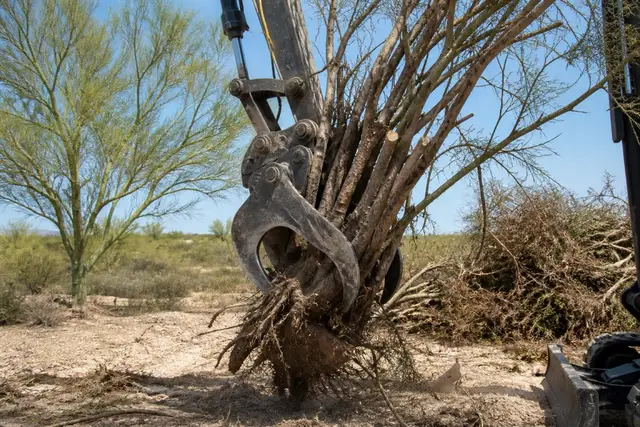
Tres Rios Land Clearing connects Avondale property owners with a local land clearing contractor for mesquite & palo verde removal in Avondale and the surrounding West Valley communities.
Ask West Valley owners which trees they most often need gone and the answer is velvet mesquite and palo verde — and the two that come back if you take them off at the dirt. Both resprout from the root crown, so a chainsaw job buys you one quiet year and then a multi-stemmed thicket worse than the original tree. Real removal means an excavator with a thumb gripping the trunk low, rocking the crown loose, and lifting root mass and all out of the ground.
There is a legal layer that surprises people. Both species are native plants regulated under Arizona law: a landowner has every right to remove trees on private property, but destruction of protected natives on larger undeveloped parcels requires notifying the Arizona Department of Agriculture in advance — the state's own window is twenty to sixty days before the work. Developed residential lots under ten acres are generally exempt, which covers most yards, but acreage owners should not skip the check. The contractor sorts which side of the line your parcel is on before anything is uprooted.
And one line drawn in permanent ink: saguaros are not removal candidates on any job this site connects. They are among the most tightly protected plants in the state, they are worth real money standing, and every scope written here treats them as fixed features the machines work around. If a saguaro sits where you hoped to build, that is a conversation about permits and specialist relocation overseen by the state — not about an excavator.
Why mesquite keeps winning until the crown comes out
Velvet mesquite is built for abuse. Cut it, burn it, browse it — the buried root crown holds carbohydrate reserves and dormant buds that push new stems within a season, and its taproot can chase moisture far deeper than any irrigation line. The University of Arizona Cooperative Extension treats mechanical grubbing of the crown as the reliable end-state for unwanted mesquite, and that is how these jobs get quoted: extraction, not amputation.
Palo verde fails differently. It grows fast, splits at weak crotches, and drops limbs in monsoon microbursts — a mature one leaning over a roof in August is a genuine hazard, not a cosmetic issue. Removal is the same crown-out process, but timing matters: the NWS Phoenix storm season is exactly when you do not want a compromised tree still standing, so hazard removals get scheduled ahead of it when owners call early enough.
The native plant law, in plain terms
Arizona's native plant statute divides regulated species into categories, with saguaros and other highly safeguarded plants at the top. The rule that touches ordinary clearing jobs is the landowner notification: before protected natives are destroyed on qualifying land, the state must be notified twenty to sixty days ahead, and salvageable plants may be claimed for relocation rather than destruction. The Cooperative Extension publishes a readable summary — Arizona Native Plant Law: What You Need to Know — worth ten minutes for any acreage owner.
What this means for your quote is sequencing. On a subdivision-lot job the exemption usually applies and work can start as soon as you accept the number. On raw acreage the notification clock may need to run first, so the walk-through happens now, the paperwork goes in, and the excavator shows up when the window opens. Skipping that step is how clearing jobs turn into public-record enforcement stories — and why the honest contractors around Avondale simply do not.
Further reading
Good to know
How much does it cost to remove a mesquite tree in Avondale?
A single mature mesquite grubbed out by the crown typically runs mid-hundreds to around a thousand dollars depending on trunk count, access, and whether the wood is hauled. Multi-tree thickets price better per tree because the machine is already on site — which is why acreage owners usually batch the work.
Is it legal to remove palo verde on my own property?
Yes, with a caveat. On a developed residential lot under ten acres you can generally remove your own palo verde without state paperwork. On undeveloped or larger land, Arizona's native plant law requires notifying the Department of Agriculture 20–60 days before protected natives are destroyed. The contractor confirms which rule applies before starting.
Can you remove a saguaro that is in the way?
No — that is not a service offered here. Saguaros are highly safeguarded under Arizona law and are never cut, pushed, or grubbed on any job this site connects. Where one stands in a building footprint, the path is a state permit and a specialist relocation, and the clearing scope is simply drawn around the cactus.
Will the tree grow back after removal?
Not if the root crown comes out — that is the whole point of grubbing over cutting. Expect some volunteer seedlings from the seed bank after a wet winter, which a follow-up mow handles cheaply. What you will not get is the cut-stump hydra of six new trunks.
What happens to the wood?
Mesquite is the one clearing byproduct people actually want. Options get priced in the quote: bucked into firewood lengths and left stacked, ground with the rest of the brush, or hauled entirely. Plenty of Avondale owners keep the mesquite and wave goodbye to everything else.