 Tres Rios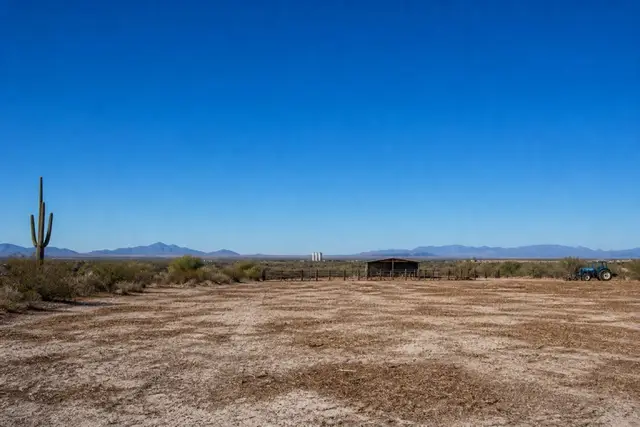
Tres Rios Land Clearing connects Rainbow Valley property owners with a local land clearing contractor for clearing, mulching, and brush work across the Rainbow Valley area.
Rainbow Valley is the southwest Valley's deep-rural answer to the subdivision map — an unincorporated expanse south of the Gila River where multi-acre horse properties, ranchettes, and genuinely remote homesites sit on creosote flats between the Estrellas and the Buckeye hills, at a population density the rest of the metro cannot imagine. Clearing out here is acreage work by definition: measured in acres and fence-miles, not squares of lawn.
The property pattern drives the scope. Owners typically hold five to forty acres, use a fraction of it hard — home, corrals, arena, hay storage — and let the balance run native. The standing jobs: keeping the used core cleared and the corrals weed-free, cutting real defensible space around structures that a fire response has to travel far to reach, maintaining long fence lines against tumbleweed and mesquite, and opening or re-opening the access roads that connect it all to the pavement.
Remote-parcel logistics are part of the trade here. Machines mobilize with fuel and spares planned, water for dust comes with the equipment rather than assumed from a hydrant, and jobs get sequenced so one mobilization covers the property's whole list — clearing, road blade, fence corridors — because the drive out is the same price whether the machine does one task or five.
Defensible space when the fire department is far away
Rural response times change the defensible-space math: structures out here need buffers built for unattended defense, which means wider cleared bands, aggressive fine-fuel control, and ember-zone discipline in the first feet around every building — the layered approach the Firewise program codifies. On creosote flats the critical fuel is the annual grass-and-tumbleweed crop between shrubs; mowed to stubble, the flat carries fire poorly, and a wide mowed apron is the single highest-value cut on the property.
Hay, fuel storage, and outbuildings extend the plan beyond the house: a burning hay barn is a property-scale event, so storage gets its own cleared radius and its own ignition-source check. The National Interagency Fire Center's seasonal outlooks are worth a glance every spring — bad grass years are visible months ahead, and the mowing budget should follow them.
Horse ground, arena pads, and the long fence
Rainbow Valley's horse infrastructure generates steady earthwork adjacent to clearing: arena pads cut and watered to a workable surface, turnout ground cleared of anything that punctures or tangles, and manure and old-bedding stockpiles managed before wind and water spread them. Every cleared area where animals will stand gets the magnet-sweep finish — decades of ranch wire live in this soil, and the extension service's equine-acreage guidance is blunt about what hardware does to hooves and guts.
Fence economics at this scale favor corridors over rescues: a driveable, mowed line along the perimeter turns every future repair into a truck job and holds the tumbleweed load down along its whole length. Owners who put the perimeter corridor on a yearly cycle — often bundled with the road blade and the defensible-space mow — spend less per year than a single crisis clear costs, and the Flood Control District's mapping flags the couple of spots on most parcels where a wash crossing needs more than a mow.
Good to know
What does multi-acre clearing cost in Rainbow Valley?
Mowing native flats runs economically per acre at this scale; grubbing, road work, and defensible-space construction price by density and spec. Most ranch-scale packages — core clear, perimeter corridor, road blade — land in the low-to-mid four figures per mobilization. One visit covering the whole list is the value play.
Can one mobilization handle clearing, roads, and fence lines together?
That is exactly how remote work should be bought. The machine spread comes out once, sequences through the property's list, and the drive-out cost gets divided across everything instead of charged repeatedly. Standing seasonal arrangements deepen the same economics.
How wide should defensible space be out here?
Wider than town standards, because response is farther away: a hundred-foot managed zone around structures is a reasonable rural baseline on brushy ground, with the inner thirty kept aggressively clean and hay or fuel storage given its own radius. The walk-through tailors it to your fuels and layout.
Do you work around livestock and horses on site?
Yes — rotation through turnouts, gates managed behind every move, no cleared ground returned to animals before its magnet sweep, and dust watered down around barns. The animals' routine is written into the day plan.
Our road washes out every monsoon. Fixable?
Usually, and cheaper than annual repair: crown the running surface, square and harden the wash crossings, and give the water a designed path instead of the wheel ruts. Where a crossing genuinely needs a culvert, the quote says so with a number rather than pretending a blade pass will hold.