 Tres Rios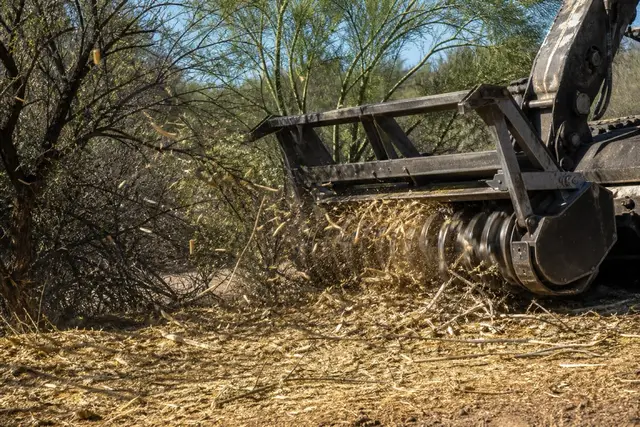
Tres Rios Land Clearing connects Avondale property owners with a local land clearing contractor for forestry mulching in Avondale and the surrounding West Valley communities.
Forestry mulching puts a drum mulcher on a track machine and grinds standing brush where it grows. On the flats around Avondale that means creosote, bursage, and volunteer velvet mesquite chewed down to chips in one pass — no push piles, no burn permits, no line of dump trucks idling on your road. The chips stay on the ground as a rough mulch blanket that shades the soil and keeps the surface from powdering into dust every time the wind picks up.
That mulch blanket matters more here than in most markets. The West Valley sits under some of the strictest fugitive-dust rules in the country, and a scraped-bare acre of caliche-crusted soil is a dust complaint waiting to happen. Mulched ground holds itself together through spring winds and monsoon outflows alike, which is why mulching is usually the first option worth pricing when the goal is a cleaner, safer, more usable piece of desert rather than a construction pad.
On cost: lead-generation guides like to quote a few hundred dollars an acre, but operator day rates tell the honest story — a mulching machine and operator runs roughly three thousand dollars a day, and most Avondale-area jobs land somewhere between the low and mid four figures depending on how thick the mesquite is and how much acreage you want opened up. A walk-through gets you a real number instead of a guess.
Why grinding beats piling and burning in Maricopa County
The old rural habit of dozing brush into piles and lighting them off is effectively finished in this county. Open burning sits behind a permit wall for most of the year, and the Maricopa County Air Quality Department enforces fugitive-dust and smoke rules across the entire metro nonattainment area. A mulcher sidesteps the whole problem: the biomass never leaves the property, nothing smolders, and there is no haul-off invoice tacked onto the job.
There is a soil argument too. Desert topsoil out here is thin and crusted, and University of Arizona Cooperative Extension soil guidance describes just how slowly Sonoran ground rebuilds a stripped crust. Chips left by the mulcher head break down slowly in the dry heat, but while they sit they stop sheet erosion during monsoon downpours and keep tumbleweed seed from finding open dirt to colonize. You get cleared land that still looks and behaves like desert, not like a graded lot.
What a mulcher can and cannot do on Sonoran scrub
A drum head makes quick work of creosote, bursage, desert broom, and mesquite up to roughly eight inches through the trunk. What it does not do is kill the root system. Velvet mesquite resprouts from the crown, so a mulched thicket will push green shoots after the first good soak — the June-through-September monsoon that the National Weather Service in Phoenix tracks each summer is usually what wakes them up. If the goal is permanent removal, the quote should say so up front, because that means grubbing crowns out with an excavator rather than mowing them off.
The other hard limit is written into state law. Saguaros and other protected natives are never in the mulcher's path — Arizona's native plant statute requires landowners to notify the state before destroying protected species, and the practical answer on a cleared lot is simpler: the machine works around them and they stay standing. Ironwood, older palo verde, and any cactus worth keeping get flagged during the walk-through so the operator has a map before the first pass.
Further reading
Good to know
What does forestry mulching run per acre around Avondale?
Expect real quotes to be built from machine time rather than a flat per-acre rate. Light creosote flat might clear at an acre or more per day, while dense mesquite bosque can slow a machine to a fraction of that. Most West Valley residential jobs land in the $1,500–$4,000 range; the free quote prices your actual vegetation, not an average.
Does the mulch left behind cause any problems?
Generally the opposite — it suppresses dust, slows monsoon erosion, and shades out tumbleweed seedlings. The one thing to know is that fresh chips are not a finished landscape surface. If the land is headed for a building pad or turf, the chips get accounted for in the grading plan.
Will mesquite grow back after mulching?
Mesquite and desert broom can resprout from the root crown, and the monsoon usually triggers it. For pasture or fire-break maintenance a re-mow every couple of seasons is normal; for permanent removal the contractor grubs the crowns out, which is quoted as a different scope.
Can a mulcher work around saguaros and other cactus?
Yes, and it must. Saguaros are protected under Arizona's native plant law and are never cut or pushed — they get flagged and the machine keeps a clean radius around them. The same courtesy is usually extended to ironwood and mature palo verde unless you specifically want them addressed through the legal notification process.
Do I need a permit to mulch brush on my own land?
Mulching itself typically needs no county permit on private residential land, but two rules can touch the job: Maricopa County dust regulations if soil ends up disturbed over a tenth of an acre, and the state native plant law if protected species are coming out rather than being worked around. The contractor walks both before the machine unloads.