 Tres Rios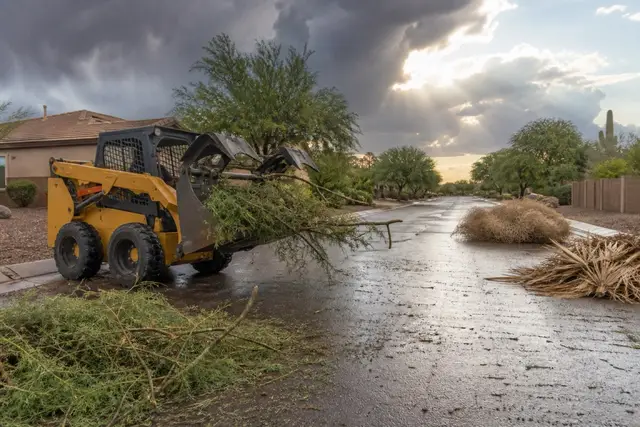
Tres Rios Land Clearing connects Avondale property owners with a local land clearing contractor for storm debris cleanup in Avondale and the surrounding West Valley communities.
Every monsoon season hands the West Valley a fresh inventory of broken trees. Microburst outflows arrive at fifty to seventy miles an hour ahead of storm cells, and the trees that fail are predictable: over-watered mesquites that grew fast and rooted shallow in lawns, aging palms shedding entire crowns, African sumac and eucalyptus splitting at co-dominant trunks. The morning after a big cell tracks over Avondale, the calls are all the same shape — something large is lying where it should not be, and it needs to be gone.
Storm work is grapple work. A machine that can lift a half-ton mesquite section clears in an hour what a chainsaw crew drags around all afternoon, and it does it without turning your yard into a skid trail. Typical scope: cut and remove failed trees and hanging limbs, clear driveways and gates first so the property functions, stage and haul debris, and flag anything — a leaning tree, a cracked union over the roof — that should come down on purpose before the next cell finishes the job at random.
The queue is the practical reality. After a major outflow event, every clearing and tree outfit in the metro is booked within hours, and jobs get sequenced by hazard: trees on structures and blocked access first, fence and yard debris after. Calling early with plain facts — what fell, what it is touching, whether anything is still hanging — moves you up the list and gets the right machine sent instead of two wrong ones.
Why desert trees fail in monsoon wind
The monsoon's signature hazard is the downburst — rain-cooled air collapsing out of a storm core and spreading as a wall of wind. The NWS Phoenix office logs these outflows every season, and the arboricultural result is consistent: trees irrigated into fast, dense canopies on shallow root plates act as sails. A native mesquite on desert rations grows slow, small, and wind-firm; the same species on lawn water grows a crown its roots never earned.
That mechanism is also the prevention list. Thinning over-dense canopies before July, staking nothing (staked trees never build taper), watering deep and rarely to drive roots down, and removing the known splitters before the season — extension horticulture guidance for low-desert trees reads like a monsoon-failure prevention manual because that is functionally what it is.
After the storm: order of operations that protects you
First, people and lines: anything involving a service drop or a power line is the utility's problem before it is anyone's chainsaw problem, full stop. Second, document — insurance adjusters want photos of the tree where it fell, so shoot everything before cleanup starts. Third, access: gates, driveways, and the path emergency vehicles would need. The county and cities clear public rights-of-way; everything inside your line is private scope.
Debris volume surprises people — a single mature mesquite becomes several dump-trailer loads once it is on the ground. Options mirror any clearing job: haul-off, grind-on-site into mulch, or buck the mesquite for firewood and haul the rest. And the storm that dropped the tree usually flags its siblings; a ten-minute walk with the operator while the machine is already on site is the cheapest hazard assessment available, ahead of a season the forecast office tracks daily through September 30.
Further reading
Good to know
How fast can someone get to my property after a storm?
Hazard cases — tree on structure, blocked access, anything still hanging — jump the queue and often get same-day or next-morning response even in a busy stretch. Yard debris without a hazard component books a few days out after big events. Describing the situation precisely on the first call is what gets it triaged right.
What does storm cleanup typically cost?
A single failed tree cut and hauled generally runs mid-hundreds into the low thousands, scaling with size, position, and haul volume — a mesquite crown through a fence costs more than the same crown on open lawn. Emergency positioning (on a roof, over a line) adds rigging time. Quotes are firm before cutting starts.
The tree is on my roof. Do I call you or my insurance first?
Photograph everything, call your insurer to open the claim, then get the tree removed — most policies cover removal from structures, and adjusters work from your photos. If a power line is involved anywhere, the utility comes before anyone else touches it.
Can a half-fallen tree be saved?
Sometimes. A young tree tipped with its root ball partly intact can occasionally be righted, staked briefly, and re-established. A mature tree that has split a main union or lifted its plate is done — re-standing it buys a worse failure later. An honest on-site call takes two minutes.
Do you handle the palm fronds and small debris too, or just the big wood?
The whole mess — grapple loads for the trunk wood, raked and loaded piles for fronds and litter, and a final pass so the yard is usable, not just passable. If you only need the big wood gone and want to handle raking yourself, the quote can be split that way.