 Tres Rios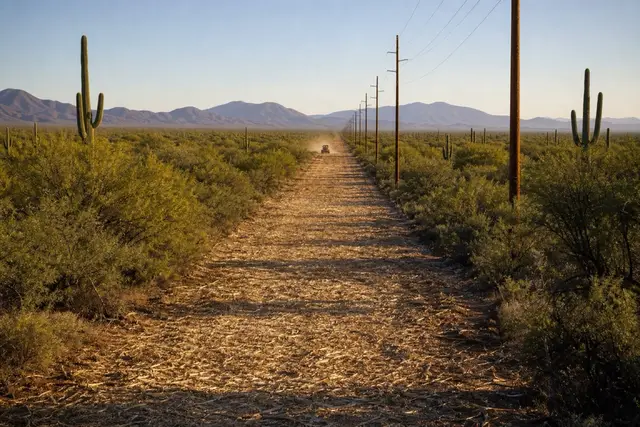
Tres Rios Land Clearing connects Avondale property owners with a local land clearing contractor for right-of-way clearing in Avondale and the surrounding West Valley communities.
Rights-of-way are corridors with jobs: a pole line that must stay reachable, an irrigation ditch that must stay serviceable, a recorded access easement that must stay passable for the parcel behind it. When desert vegetation closes one, the obligation does not close with it — and around the southwest Valley's mix of legacy farm infrastructure and new development, ROW clearing is steady, unglamorous, essential work.
The typical private-side call list: shared easement drives grown shut between rural parcels; ditch and drain banks on legacy irrigation systems where root intrusion threatens the lining; developer-held corridors that need to be opened for survey, geotech, or utility installation; and private pole or pipeline runs on large parcels where the utility handles its own wire but the landowner handles the ground. Machinery matches corridor width — compact mulchers for narrow runs, full-size heads where the easement gives room to work.
What distinguishes corridor work from lot work is linearity and neighbors. A two-mile run crosses soil changes, wash crossings, gates, and property moods, and the operator has to manage all of them in sequence without leaving windrows blocking anyone's access. Utility-scale transmission ROW under long-term maintenance contract is its own B2B world; what this site connects is the private and small-scale end, quoted per corridor after it is walked or driven.
Easement law meets desert regrowth
An access easement that brush has closed is still an easement — recorded rights do not lapse because mesquite grew through them — but practical access disputes get ugly precisely when the corridor is impassable and someone needs it opened this month. Clearing a recorded corridor to its recorded width, documented with before-and-current photos of the vegetation state, keeps the work defensible; parcel records from the county settle where the corridor actually runs, which is not always where the existing two-track wandered.
On corridors that cross undeveloped desert, the state native-plant rules apply the same as anywhere: protected species in the alignment are worked around where the corridor width allows, and where they genuinely cannot stay, the notification process runs before the machine does. Saguaros in a ROW are treated as immovable by this operation — corridors bend a few feet far more cheaply than the law bends at all.
Holding a corridor open for the cheap half of its life
The first clearing of an overgrown corridor is the expensive event; everything after is maintenance pricing, provided it happens on schedule. Desert regrowth gives a generous grace period — creosote is slow, and even mesquite regrowth takes seasons to re-close a properly grubbed line — so a cycle of one maintenance mow every year or two holds most corridors indefinitely at a fraction of reclearing cost. The corridors that get expensive are the ones cleared once, forgotten, and rediscovered at full density a decade later.
Fire adds a public-interest angle to pole-line corridors specifically. Dry fuels under and against poles are an ignition and equipment-loss pathway that the fire community tracked by the National Interagency Fire Center takes seriously in every western state, and the monsoon's dry-lightning and equipment-stress season documented by NWS Phoenix is when a clean corridor earns its keep. Landowners with private runs are the ones who carry that maintenance; it is cheap insurance measured against what it protects.
Further reading
Good to know
How is right-of-way clearing priced?
Per corridor, after it is walked or driven — length, width, density, and access points set the number. Private easement and ditch-bank runs commonly land in the low-to-mid four figures; long or dense corridors scale from there. Maintenance re-mows after the initial clear price far lower.
Can you clear a shared easement if my neighbor objects?
The recorded easement defines the right, and clearing within its recorded width to restore the access it exists for is the textbook use of that right. That said, notice and a copy of the recorded document smooth nearly every version of this conversation — and the quote visit can help confirm the corridor's location against the plat before anything is cut.
Do you handle the vegetation under power lines?
On private runs — the pole line serving one property, or a landowner-maintained corridor — yes, with appropriate clearances from energized equipment and the serving utility's requirements respected. Distribution and transmission corridors the utility itself maintains are theirs; report those through the utility.
What happens to protected plants inside the corridor?
Worked around whenever the corridor width allows, which is most of the time. Where a protected native genuinely conflicts, the state notification process runs first. Saguaros are never removed on these jobs — the corridor shifts, the saguaro stays.
How often does a cleared corridor need maintenance?
Every one to two years for a light mow, depending on rain cycles and how thoroughly the initial clear grubbed the woody crowns. That cadence holds a corridor indefinitely at maintenance prices; skipping a decade returns the corridor to first-clearing prices.