 Tres Rios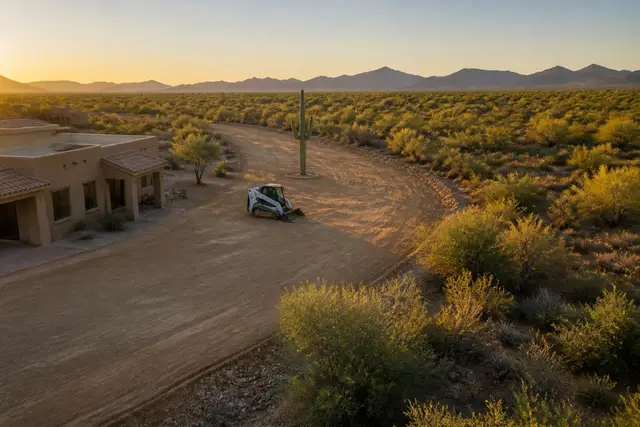
Tres Rios Land Clearing connects Avondale property owners with a local land clearing contractor for defensible space & fire mitigation clearing in Avondale and the surrounding West Valley communities.
Desert fires are grass fires. The creosote flat itself burns poorly, but the invasive winter growth threading through it — red brome, stinknet, dried mustards, and in bad years a continuous tumbleweed mat — carries flame from a roadside spark to a back wall in minutes. Homes on the desert edge in Rainbow Valley, Waddell, and the acreage pockets south of the Gila sit directly on that fuel bed, and defensible space is the difference between a blackened fence line and an insurance claim.
The work itself is straightforward machinery time with judgment attached. A cleared band goes in around structures — bare or gravel ground in the first several feet, then a wider zone where brush is thinned to islands, dead material is removed entirely, and anything overhanging a roofline gets cut back. Fine fuels are mowed to stubble across the outer zone. Judgment is what keeps it looking like landscape instead of a moonscape: healthy natives stay as spaced specimens, washes keep their bank vegetation, and every saguaro inside the zone is preserved with a clean-raked radius around it, exactly as state law expects.
Timing is the cheapest upgrade. The fuel that burns in June grew in February, so the effective schedule is a late-spring cut after the annuals die but before fire season peaks, with a mid-monsoon touch-up in wet years when a second green-up appears. An annual maintenance mow costs a fraction of the initial clear and keeps the buffer rated for the season it exists to survive.
The zone logic, translated to Sonoran ground
The national framework comes from the NFPA's Firewise program: an ember-resistant area in the first five feet of the house, aggressive fuel reduction to thirty feet, and thinning out to a hundred where lot size allows. On desert parcels the translation is specific — rock mulch instead of bark against the wall, oleander hedges (a torch when dry) moved out of the near zone, woodpiles and dead palm skirts out past thirty feet, and the brome-and-stinknet carpet mowed before it cures in May.
Embers, not flame fronts, take most structures, which is why the home-preparation research puts so much weight on the first five feet. A machine crew handles the vegetation zones; the walk-through will also flag the free fixes — debris in wall corners, brush touching a wood fence that runs straight to the eaves — because clearing the lot and leaving a fuse attached to the house misses the point.
Why West Valley fire risk is rising, and what it costs to blunt
Fire agencies tracked through the National Interagency Fire Center have watched the Sonoran Desert shift from a landscape that rarely carried fire to one that burns in bad grass years, driven by invasive annuals that cure into a continuous fuel bed. The southwest Valley's mix — desert edge, dry river corridors full of tamarisk, and steady wind — concentrates that risk exactly where the acreage homes are.
Cost scales with the starting condition. A maintained parcel needs an annual mow of the outer zone, often just a few hundred dollars of machine time. A first-time clear on brush-choked acreage is a real project — thinning, dead removal, haul-off — that typically lands in the low four figures per acre treated. Between those bookends sits the renewal case: buffers cut years ago and let go, where the monsoon's growth cycles have quietly refilled the space. A quote visit reads the fuel, not the calendar.
Further reading
Good to know
How wide should defensible space be around a desert home?
The Firewise structure is five feet of ember-resistant ground, hard fuel reduction to thirty, and thinning to a hundred where the lot allows. On flat creosote ground with light fuels, the thirty-foot band does most of the work; against a tamarisk wash or heavy mesquite, the wider zone earns its keep.
Do saguaros and native trees have to come out of the buffer?
No — and saguaros never do, period. A green, spaced saguaro or a raised-canopy palo verde is not the fuel problem; the dead grass and brush packed around it is. The crew clears the fine fuels, rakes a radius around keeper plants, and leaves the desert character intact.
When is the best time to cut fire fuels in the West Valley?
Late spring, after winter annuals like red brome and stinknet have finished growing but before peak fire season. In wet monsoon years a second light mow in early fall handles the summer green-up. Cutting in winter mostly wastes money — the fuel that matters has not grown yet.
What does a defensible space project cost?
An annual maintenance mow on a kept-up parcel is often a few hundred dollars. A first-time clear of overgrown acreage — thinning, dead-material removal, haul-off — typically runs low four figures per treated acre. The quote separates the one-time restoration from the yearly upkeep so you can budget both.
Does defensible space actually help with insurance?
Insurers in wildfire-exposed zip codes increasingly ask about clearances, and photographic proof of a maintained buffer is useful documentation in any conversation with them. No contractor can promise premium outcomes — what the work verifiably does is change how fire behaves when it reaches your line.