 Tres Rios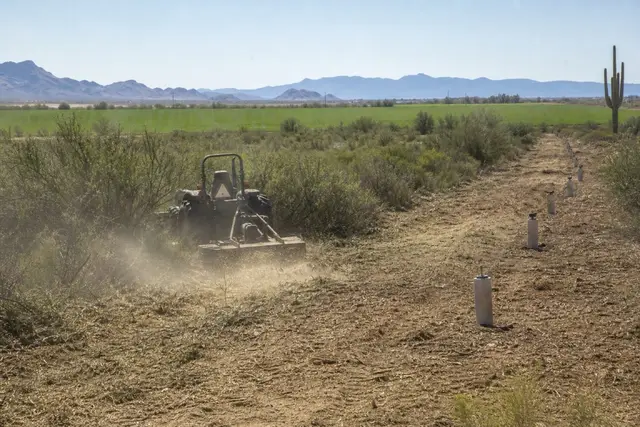
Tres Rios Land Clearing connects Palo Verde property owners with a local land clearing contractor for clearing, mulching, and brush work across the Palo Verde area.
Palo Verde is about as far west as the Valley's farm country runs — a small unincorporated settlement on the historic Highway 80 alignment southwest of Buckeye, farmed since the 1880s and still surrounded by working alfalfa and grain ground on the flats toward the Gila. Clearing work out here is field-country work: acreage, ditches, fence miles, and the mesquite that runs any corner agriculture lets slip.
The classic Palo Verde job is the invaded field edge. A corner that missed a few seasons of water grows a mesquite colony; the colony seeds the ditch bank; and within a decade a productive field has a woody border stealing its water and shading its rows. Reclamation grubs the colony at the crowns, cleans the ditch runs, and hands the corner back to the field — with a cheap annual mow thereafter keeping the seed bank's counterattack to seedling size.
Distance shapes the logistics the same way it does everywhere in the far west Valley: mobilization is real money, so work is batched, water for dust travels with the machines, and a single visit is planned to cover the parcel's full list. For the area's farm operators and acreage owners alike, the pattern that works is seasonal — a planned pass in late spring, a check after monsoon — rather than crisis response.
Mesquite versus the irrigated field
Velvet mesquite is native, useful, and — from a farmer's perspective at a field edge — a water thief with a seed strategy. Livestock and wildlife move the pods; any unirrigated strip lets seedlings establish; and established trees push roots toward exactly the moisture the field is paying for. Field-edge control is therefore a rotation, not an event: grub the established colony once, then hold the line with an annual mow of the strip, a rhythm extension range and agronomy guidance has recommended in one form or another for generations.
Ditch banks deserve the same discipline with higher stakes: root intrusion in a lined ditch is infrastructure damage, and an unlined one loses flow to every thicket along its run. Bank clearing that extracts roots without collapsing the section keeps water moving at design rate — and on shared laterals, keeps peace among everyone downstream.
Far-west parcels and the practical rules
Palo Verde's ground sits in unincorporated Maricopa County within Buckeye's planning sphere, and the applicable rulebook is the county's: dust control above the disturbance threshold — a working reality on any field-scale job here, where water trucks are part of the spread — and the state native-plant law on undeveloped desert parcels, with its notification clock for protected species. Farm-field reclamation itself typically deals in regrowth rather than protected specimens, but desert-parcel jobs on the area's edges get the full survey-first treatment.
Monsoon is the schedule's pivot out here just as it is metro-wide: the Phoenix forecast office's mid-June-through-September season brings the dust events that halt open-ground work and the storm flows that reshuffle every wash and ditch. The productive rhythm books big clearing pushes into fall-through-spring and reserves summer for storm response — a calendar the local farm operations have kept for a century for the same reasons.
Further reading
Good to know
What does field-edge reclamation cost near Palo Verde?
Grubbing an invaded corner or edge typically lands in the low-to-mid four figures depending on colony age and disposal, with the follow-up annual mow costing a small fraction of that. Quotes come from walking the actual edge — mesquite age changes the machinery answer.
Do you travel this far west without a huge trip charge?
Mobilization is priced honestly and stretched across as much work as the visit can hold — which is why batching the parcel's whole list into one trip is always the recommendation out here. Seasonal arrangements make the economics better still.
Can you clear ditch banks without wrecking the ditch?
Yes — extraction happens with the machine positioned off the section, roots come out away from linings, and spoil stays out of the channel. Intrusion damage that already exists gets flagged while the bank is open, when repair is cheapest.
Is a dust permit needed for clearing a field corner?
County dust rules engage once disturbance passes the threshold, and field-scale work usually does — so water is part of the spread and the compliance question is answered in the quote, not improvised on site. Agricultural operations have their own provisions, which the contractor sorts by parcel and activity.
When is the best season for big clearing work out here?
Fall through spring. The ground works better, dust is controllable, debris is dry and cheap to handle, and the job finishes before monsoon reshuffles the drainage. Summer is for storm cleanup and small urgent scopes at first light.