 Tres Rios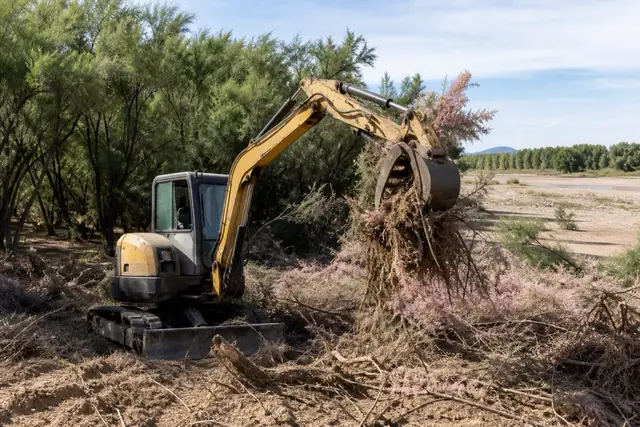
Tres Rios Land Clearing connects Avondale property owners with a local land clearing contractor for salt cedar & invasive removal in Avondale and the surrounding West Valley communities.
Salt cedar — tamarisk — is the defining invasive of the three-rivers country this brand is named for. Introduced a century ago for erosion control, it now chokes miles of the Gila and Agua Fria bottomlands south and west of Avondale: a feathery, pink-flowering thicket that drinks prodigiously, salts the soil surface with its leaf litter, crowds out the mesquite bosque and cottonwood-willow habitat, and burns like a torch when it dries. Property that touches a river bottom, an old irrigation drain, or a low wash almost always has some.
Cutting tamarisk is a haircut, not a removal. The plant resprouts vigorously from its root crown, so the working method on private land is mechanical extraction — an excavator thumb ripping each clump out at the roots, the debris windrowed and hauled or ground, and the ground left ready for follow-up treatment of whatever tries to return. Where infestations are dense, a season-later check visit is honest scope, not an upsell: whatever fraction of crowns survived the pull will show themselves after the first irrigation or storm flow.
The same call handles the rest of the invasive roster moving through the West Valley: stinknet, whose winter carpets have made allergy and fire news across the metro; fountain grass and buffelgrass escaping from old landscaping; and giant reed clogging ditch banks on legacy farm parcels. Different plants, same logic — get the root system, get the seed load off the property, and stop treating regrowth season as a surprise.
What tamarisk does to a river-bottom property
The federal invasive-species program keeps a plain-language profile of saltcedar, and the highlights read like a landowner's complaint list: deep roots that out-compete natives for water, salt deposition that suppresses everything under the canopy, dense stands that trap sediment and reshape channels, and dry-season fuel loads that carry fire along waterways. On the Gila south of Avondale, all four are visible from the levee roads.
Flow is the property-value angle. A tamarisk-packed channel passes less water, and when a monsoon surge does come down the Flood Control District's watercourses, thickets snag debris and shove water sideways — sometimes toward structures that stayed dry for decades. Clearing invasives out of private drainage paths is one of the few clearing jobs that pays for itself in avoided flood repair.
Getting removal to actually stick
Root-crown extraction beats cutting, but tamarisk seeds prolifically and the bank you cleared sits downstream of banks nobody cleared. A realistic plan stacks three things: full mechanical removal of standing plants, disposal that leaves no viable material on site, and a scheduled recheck after the next wet cycle — the monsoon is the germination bell out here. Owners who budget the recheck keep clean banks; owners who skip it meet the thicket again in three summers.
Native replacement is the long game. Where tamarisk comes out, velvet mesquite, wolfberry, and quailbush move back readily if given a season without competition, and the difference shows in wildlife within a year — the constructed wetlands at the Tres Rios project just downstream are the region's proof that restored bottomland outperforms invaded bottomland by every measure a landowner cares about, from bird life to fire behavior.
Further reading
Good to know
How much does salt cedar removal cost?
It prices like dense-vegetation excavation: by machine time and disposal volume rather than acreage alone. Small residential infestations — a ditch bank, a fence corner — often clear in the low four figures; long river-bottom stands are quoted after a walk of the actual bank. Extraction with roots costs more than cutting and is the only version worth buying.
Why not just cut tamarisk down and be done?
Because it resprouts from the root crown almost without fail, and the regrowth comes back denser. Mechanical removal pulls the crown and major roots out of the bank. Cut-only work is appropriate only as temporary fire-fuel reduction with a plan to finish the job.
Is removing salt cedar legal? It grows along the river.
On your own land, yes — tamarisk is an introduced invasive, not a protected native, so Arizona's native plant law does not shield it. What does apply is common sense near watercourses: work in a floodway or a district-maintained channel should be coordinated so cleared debris and bank disturbance do not create a downstream problem.
What is the best time of year for invasive removal?
Fall through spring. The ground still gives up roots, the debris is drier and cheaper to haul than monsoon-soaked material, and removal finishes before the summer germination window. Stinknet specifically wants winter work — pulling it after it browns in late spring mostly redistributes seed.
Will the natives come back after the tamarisk is gone?
Usually, and faster than people expect. Mesquite, saltbush, and wolfberry recolonize cleared bottomland readily once the salt-crusted litter layer is scraped with the removal. Owners who want to speed it up can seed or plant natives in the first winter; either way, the recheck visit keeps tamarisk seedlings from stealing the head start.