 Tres Rios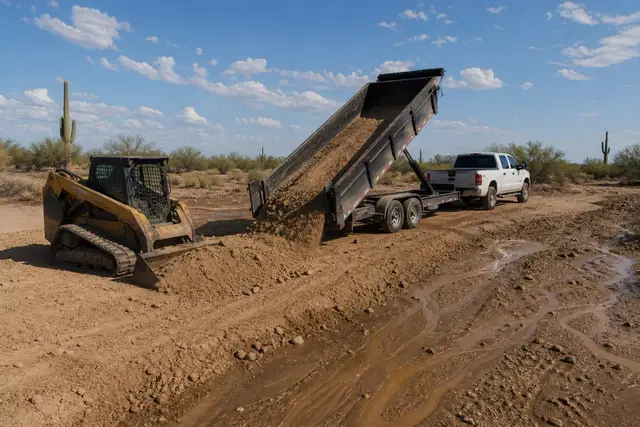
Tres Rios Land Clearing connects Avondale property owners with a local land clearing contractor for fill dirt services in Avondale and the surrounding West Valley communities.
Fill dirt jobs in the southwest Valley are mostly monsoon repair with a shovel schedule: the low corner of a lot that ponded again, the rill network a July storm carved beside the driveway, the trench settlement over last year's utility work. The service is simple to describe and easy to do badly — clean fill sourced and delivered, spread in controlled lifts, moisture-conditioned, and compacted so the correction survives the storm that created the need.
"Clean" is the word doing the work. Good fill out here is native-type sandy loam or aggregate-blended material free of construction debris, green waste, and expansive clay imports. What shows up from a bargain listing is often none of those things, and buried trash or organic material becomes tomorrow's settlement. Sourcing through a contractor buys the boring virtues: known material, honest yardage on the ticket, and a dump trailer that puts each load where the spread plan wants it instead of one mountain at the gate.
Compaction is the difference between a repair and a redo. Dry desert fill dumped thick and driven over will firm up on the surface and consolidate the first time water reaches depth — the classic re-appearing low spot. Lifts of a few inches, watered to optimum moisture, compacted before the next lift goes down: slower to build, and the only version that stays at grade through a full monsoon cycle.
Matching fill to the job it has to do
Not all dirt is interchangeable. Structural fill under anything that bears load wants graded material compacted in verified lifts; general fill for landscape correction can be looser-spec native soil; drainage-sensitive spots sometimes want aggregate rather than soil at all, because West Valley caliche layers refuse to let water soak away — a soil behavior the UA Cooperative Extension documents thoroughly for low-desert ground. Naming the end use in the quote conversation gets the right material the first time.
Quantity estimating is straightforward once someone measures: length times width times depth, converted to cubic yards, plus a compaction allowance — placed fill loses volume as it densifies. Common residential corrections run from a few yards (a single washout) to a few dozen (raising a pad corner), and per-yard delivered pricing in Arizona sits near the $20-a-yard national norm, before spreading and compaction time.
Fixing the washout without re-buying it next summer
A washout is a symptom; the disease is concentrated flow. Filling the hole without redirecting the water schedules the same repair for next season, so the fix that lasts pairs fill with a drainage tweak — a re-crowned surface, a swale that gives the storm a better path, or armoring where flow concentration is unavoidable. Last summer's flow paths are written on the ground in rills and stains, and the Phoenix NWS storm archives will confirm what the ground already says about how the water arrived.
Where the failing spot sits near a mapped watercourse or a shared drainage easement, a quick check against Flood Control District mapping is due diligence — raising grade in a flow path can move a flooding problem onto a neighbor, which is both bad engineering and a fast way to meet the county. Ordinary yard corrections clear this check trivially; it exists for the parcels where it matters.
Further reading
Good to know
What is delivered fill dirt running around Avondale?
Arizona delivered pricing runs close to the roughly $20-per-cubic-yard national norm for clean general fill, with structural and aggregate materials higher. Spreading and compaction are machine-time line items on top. Small jobs carry delivery minimums, so batching corrections into one visit pays.
How many yards do I need?
Measure the footprint, estimate average depth, multiply, and convert: length × width × depth in feet, divided by 27. Then add compaction allowance — placed fill densifies as it is compacted. Send photos and rough dimensions with the quote request and the estimate comes back with honest yardage.
What is the difference between fill dirt and topsoil?
Fill is structure; topsoil is horticulture. Fill raises and shapes grade and should be free of organics precisely because organics decompose and settle. Topsoil goes on top, where things grow. Using topsoil as deep fill buys settlement; using fill as a planting medium buys disappointment.
Why did my last fill job sink?
Almost always one of two reasons: uncompacted placement (dumped thick, rolled once, consolidated when the monsoon soaked it) or dirty material decomposing underground. The remedy is excavating soft spots, then rebuilding in watered, compacted lifts with clean material — done right, grade holds through wet seasons.
Can you fix the drainage at the same time?
That is the recommended package. Fill without flow correction is a recurring subscription; fill plus a re-crown or swale is a one-time fix. The machines and operator are already on site, so the drainage tweak is usually a modest addition to the same mobilization.