 Tres Rios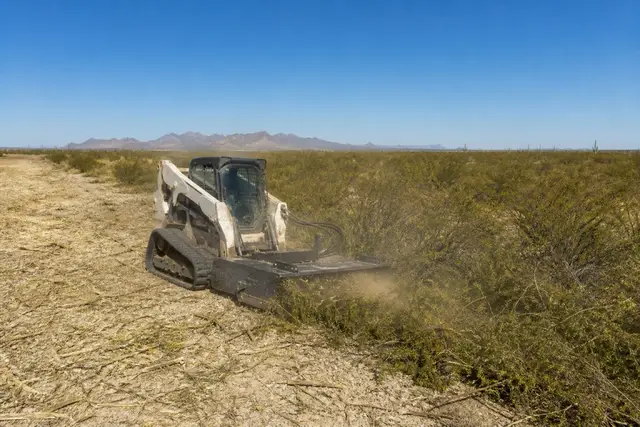
Tres Rios Land Clearing connects Avondale property owners with a local land clearing contractor for brush & underbrush clearing in Avondale and the surrounding West Valley communities.
Brush work in the southwest Valley is mostly about four plants: creosote bush that owns every unwatered flat, triangle-leaf bursage filling the gaps between them, Russian thistle — tumbleweed — stacking itself against fences each spring, and desert broom colonizing any lot that ever had irrigation. A skid-steer with a brush cutter takes all of it down fast, and a grapple picks up what should not stay.
The reasons people call are practical. Overgrown lots next to occupied homes harbor pack rats, and pack rats find their way into engine bays and attic spaces. Dry brush against a block wall is the fuel that turns a stray firework or a tossed cigarette into a fire call. And the City of Avondale, like most West Valley municipalities, can cite property owners when weeds and brush on a parcel get tall enough to be a nuisance — cheaper to clear it on your schedule than the city's.
Scope is flexible in a way full clearing is not. Plenty of owners want the creosote thinned rather than erased, a wash left in native condition through the middle of a parcel, or a screen of mesquite kept along a property line for privacy. The walk-through settles what stays, what goes, and whether the cut material gets mulched in place or hauled — and the quote itemizes it so the trade-offs are visible.
Tumbleweed, pack rats, and the case for clearing before June
Russian thistle germinates with winter rain, grows through spring, then dies, snaps off, and rolls. By the time monsoon outflow winds arrive — the Phoenix NWS office pegs the season at June 15 through September 30 — a neglected parcel can bury a fence line in dead, highly flammable skeletons. Clearing in late spring, after the last germination flush but before the first big outflow, gets you a full season of clean fence for one mobilization.
The habitat problem runs on the same calendar. White-throated woodrats — pack rats — build middens in exactly the kind of layered dead brush an untended lot produces, and Arizona Cooperative Extension guidance on managing them starts with removing the cover, not setting traps. Take away the brush pile and the cactus tangle within a hundred feet of structures and vehicles, and the wiring-chewed-through problem mostly leaves with it.
Keeping the desert while losing the hazard
Good brush clearing on Sonoran ground is selective. Creosote regrows slowly and holds soil; a thinned stand at ten- to fifteen-foot spacing reads as tidy desert rather than scraped dirt, and it keeps the surface crust intact so the parcel does not become a dust source the county dust program would take an interest in. Saguaros, where a parcel is lucky enough to have them, are protected by state law and stay exactly where they stand.
Washes deserve their own line in the plan. Even a modest desert wash moves serious water during a monsoon burst, and stripping its banks trades brush for erosion. The usual spec keeps woody root structure on the banks, clears the deadfall and debris jams out of the channel itself, and leaves flow paths the way the Flood Control District of Maricopa County generally wants to see them — open, but not bare.
Further reading
Good to know
What does brush clearing cost for a typical West Valley lot?
Most quarter-acre-to-an-acre residential brush jobs in the Phoenix metro land in the low-to-mid four figures, driven by density and disposal. Thinning creosote on a flat parcel is the cheap end; grubbing a decade of desert broom and hauling it is the expensive end. The itemized quote splits cutting from disposal so you can choose.
Can you clear brush but keep the lot looking like natural desert?
Yes — selective thinning is a normal request. The operator flags keeper plants with you first, cuts the rest, and grinds or hauls the slash. Spaced creosote and kept palo verde read as intentional xeriscape rather than an abandoned parcel.
Is there a best season for brush removal around Avondale?
Late spring is ideal: tumbleweed has finished germinating, snakes are visible rather than dormant-and-surprising, and the work is done before monsoon winds pile dead material against structures. That said, machines run year-round here — summer jobs just start at first light.
Will clearing brush get rid of pack rats and snakes?
It removes what attracts them. Rodents want layered cover and shade; rattlesnakes follow the rodents. Once the dead brush, wood piles, and low tangles near structures are gone, both tend to relocate to better habitat. No contractor can promise a snake-free parcel, but cover removal is the step every wildlife agency recommends first.
Do you remove the cut brush or leave it?
Your choice, priced both ways. Mulching in place is usually cheaper and helps with dust; hauling makes sense when the material is diseased, half-burned, mixed with trash, or the lot is being staged for construction. Many jobs split the difference — grind the native brush, haul the junk.