 Tres Rios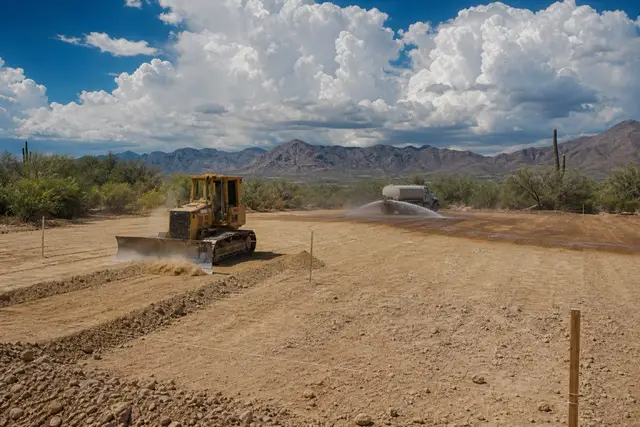
Tres Rios Land Clearing connects Avondale property owners with a local land clearing contractor for grading & site prep in Avondale and the surrounding West Valley communities.
Grading in the southwest Valley starts with a material nobody east of Texas has to think about: caliche. The calcium-carbonate hardpan that cements West Valley subsoil can sit inches under the surface in unpredictable lenses — soft enough to blade through in one spot, hard enough to laugh at a ripper tooth twenty feet away. Site prep here means reading that ground, ripping where the pad needs uniform compaction, and knowing when a lens is better worked around than fought.
Water discipline is the second local skill. Dry desert soil will not compact — it pulverizes — so pads and driveways get watered to optimum moisture as they are built up, usually with a water truck cycling between lifts. The same truck is doing regulatory duty: any project disturbing more than a tenth of an acre falls under Maricopa County's fugitive-dust rules, which require an approved dust-control plan and, above thresholds, a permit. A grading contractor who shows up without water is telling you something.
Drainage is where desert grading earns or loses its money. Seven-ish inches of annual rain sounds like nothing until half an inch of it arrives in forty minutes of monsoon and finds every low spot on the parcel. Pads get crowned, driveways get sloped away from structures, and flow paths get set so storm water leaves the way it should — because out here, erosion does not nibble at bad grading; it trenches it in a single afternoon.
Caliche: the hardpan that runs the schedule
Caliche forms as carbonate accumulates in arid-soil horizons over millennia, and University of Arizona Cooperative Extension soil guidance treats it as a defining feature of low-desert ground: nearly impermeable, brutally hard when thick, and patchy in a way that makes soil borings worth their cost on bigger jobs. For a pad, patchiness is the enemy — a slab bearing partly on ripped caliche and partly on soft fill settles differentially unless the prep equalizes it.
The practical playbook is rip, moisture-condition, and re-compact in lifts, verifying density as you go. Where a lens is too thick to rip economically, the design adapts — raise the pad, or in drainage work, accept that water will not soak through caliche and route it on the surface instead. That second point is why dry wells and soak-away pits fail in this soil, and why surface drainage design matters more here than almost anywhere the Flood Control District maps.
Dust rules are part of the job, not an extra
The Phoenix metro is a federal nonattainment area for coarse particulates, and the enforcement instrument that touches earthwork is the county dust program: an approved control plan for qualifying projects, water or palliative on disturbed soil, track-out control at pavement, and operations that stand down when wind makes control impossible. The county's dust-control pages spell out thresholds and training requirements, and inspectors do drive the West Valley.
For an owner, the takeaway is contractual: dust compliance belongs in the quote, named, with water on site every working day. Fines land on operators and owners alike, and a stop-work order costs more than a season of water-truck time. Monsoon wind events — the walls of dust the Phoenix NWS warns on all summer — are exactly when an unwatered site becomes the neighborhood's problem and the county's case file.
Further reading
Good to know
What does grading and site prep cost in the West Valley?
Metro-area grading tickets average around $1,700–$1,800 for typical residential scopes — a building pad, a long driveway cut, drainage correction — with caliche ripping and imported fill the two big variables. Larger site work is priced from a plan or a walk-through rather than a square-foot table.
Do I need a dust permit for my project?
If more than a tenth of an acre of soil gets disturbed in Maricopa County, dust rules apply and a permit with an approved control plan is required above that threshold. The contractor handles the plan, the water, and the track-out control — but it belongs in the quote, so ask to see it named.
What is caliche and why does it change the price?
A natural cement-like hardpan of calcium carbonate common under West Valley soil. Thin layers rip and recompact fine; thick lenses slow machines, wear teeth, and occasionally justify redesigning around them. Because it varies foot to foot, honest quotes flag caliche as the contingency it is.
Can you fix the drainage around my house without full regrading?
Often, yes. Many monsoon flooding problems trace to a settled low spot, a blocked flow path, or a driveway pitched the wrong way — correctable with targeted cuts and fill rather than a full site regrade. The quote visit reads where water actually went in the last storm, which the stains and rills reliably record.
How is a pad kept from settling later?
Moisture-conditioned fill placed in thin lifts, each compacted before the next, over subgrade that was ripped and re-compacted to uniform density. The desert-specific failure is dry fill dumped thick and rolled once — it tests firm and then consolidates the first time monsoon water reaches it.