 Tres Rios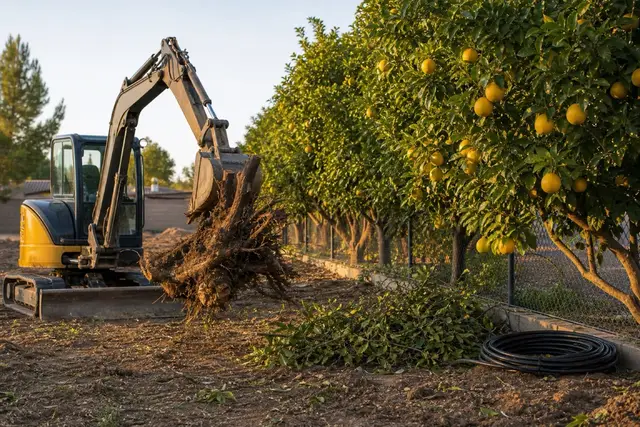
Tres Rios Land Clearing connects Citrus Park property owners with a local land clearing contractor for clearing, mulching, and brush work across the Citrus Park area.
Citrus Park wears its history in its name: a grove community grown into a census-designated place of 5,194 residents (2020 Census, up 28.9 percent in a decade) whose irrigated large lots between Goodyear and Glendale still carry grapefruit and orange rows from the area's producing years. Clearing here is estate-lot work with an orchard vocabulary — retiring failing trees, preserving keeper rows, and converting grove ground to whatever its owners need next.
The signature project is the partial conversion. An acre lot with sixty legacy citrus keeps its best fence-line row for fruit and shade, retires the interior block where half the trees have failed, and gains a pad site, a paddock, or simply open irrigated ground. Execution details decide the outcome: keepers' roots protected from compaction, retirees grubbed with full root plates, irrigation re-plumbed so the kept row still waters, and the reclaimed interior finished smooth enough to maintain.
Because Citrus Park lots are irrigated, the weed pressure is desert-plus: Bermuda mats, seasonal annuals at lawn density, and volunteer trees anywhere water reaches. Owners who hold their ground with a couple of scheduled cuts a year keep it looking like the estate community it is; ground left alone here overgrows faster than anywhere on the west side, purely because the water is there.
Retiring old citrus the right way
A failing citrus tree is a removal project with roots that fight back: dense, shallow plates that regrow suckers from fragments and leave pavement-tenting stubs when sheared instead of grubbed. Proper retirement lifts the plate whole, backfills and compacts the hole, and — where replant is planned — accounts for the replant-disease caution that orchard practice observes about putting new citrus straight into old citrus ground, a topic the UA Cooperative Extension's citrus resources cover for exactly this Valley.
Keeper rows get the mirror-image care: root zones fenced off from machine traffic, drip or flood delivery verified live after the surrounding work, and canopies cleaned on their own schedule rather than in the demolition's rhythm. A kept row that thrives afterward is the visible proof the job was done in the right order.
Large lots between two growing cities
Citrus Park's growth pressure comes from both sides — Goodyear to the south, Glendale to the east — which makes its remaining irrigated large lots an increasingly scarce commodity, a trend the county's decade-over-decade growth numbers state plainly. For owners, clearing decisions are value decisions: ground kept irrigable and maintained holds the estate character buyers pay for, while ground let go reads as a teardown lot regardless of what the trees once were.
The community's unincorporated status puts county rules in charge of the practical layer — dust control once disturbance crosses the threshold, standard utility locates before grubbing in ground threaded with decades of irrigation pipe — and the walk-through settles jurisdictional questions parcel by parcel. It is orderly work on orderly land, and the quote should read that way: itemized by tree, row, and area, with nothing vague. Citrus Park drainage planning can start with maps from the Flood Control District of Maricopa County.
Further reading
Good to know
What does it cost to clear old citrus from a lot in Citrus Park?
Priced by the tree and the plate: individual retirements run low-to-mid hundreds each with volume discounts across a block, and full interior conversions on acre-class lots typically land in the mid four figures including grubbing, hauling, and finish grading. Keeper-row protection is written into the scope.
Can we keep some producing trees through the clearing?
Yes — that is the standard Citrus Park request. Keepers are flagged, their root zones protected from traffic, and their irrigation verified working after the surrounding removals. The kept row should look better after the job than before it.
What happens to all the citrus wood?
Citrus is dense, excellent firewood and smoking wood, so options get priced: bucked and stacked for the owner, hauled entirely, or ground with the brush. Diseased material is hauled rather than left, which the on-site assessment determines.
Can new citrus be planted where old citrus came out?
With care — orchard practice cautions about replanting citrus directly into long-occupied citrus ground, and success improves with full root-plate removal, soil rest or amendment, and disease-aware stock selection. For a fence-line replacement row the practical answer is usually yes, done thoughtfully.
How do we keep the cleared interior from overgrowing again?
Scheduled cuts — irrigated ground here regrows fast enough that two or three maintenance mows a year are the realistic hold. Owners pairing the mow schedule with irrigation management keep estate-grade appearance for a small annual number.