 Tres Rios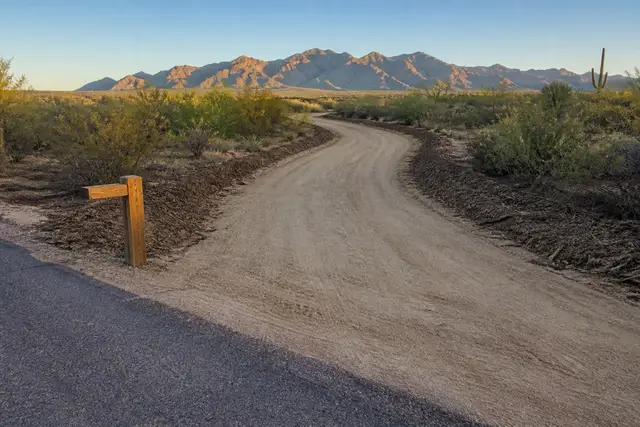
Tres Rios Land Clearing connects Avondale property owners with a local land clearing contractor for access road & driveway clearing in Avondale and the surrounding West Valley communities.
Multi-acre desert parcels in Rainbow Valley, Waddell, and the country south of the Gila share a defining feature: the buildable spot is rarely at the road. Getting to it takes a corridor — brush cleared, root crowns out, high spots knocked down, low spots filled — wide enough for a concrete truck to make the trip when building starts, and passable enough for a two-wheel-drive the rest of the year.
A desert access road that lasts is built with the water in mind before the wheels. The route reads the ground: crossing washes square rather than diagonally, holding natural grade where possible, and leaving bank vegetation on either side of each crossing so monsoon flow passes through without taking the road with it. The surface gets crowned so water sheds sideways instead of running down the wheel ruts — the single detail that separates a road from a future gully.
Scope runs from a weekend-sized job to real construction. Clearing a quarter-mile of light creosote corridor and rough-grading it is quick machine work in the $1,800 neighborhood most metro guides quote for driveway clearing; adding imported base, culvert pipe at a live wash, or dust-controlled surfacing scales it up. The walk-through settles the route, the standard, and the number before anything is cut.
Routing a corridor through Sonoran ground
The cheapest road is the one the land already suggests. Straight lines drawn on a plat cross washes at bad angles and fight grade; a routed corridor follows the ridgelets, hits each wash where the banks are low and square, and dodges the features that cost money or paperwork — thick caliche lenses, and every protected native plant the route can avoid. Saguaros on the alignment are routed around as fixed objects; where mesquite or palo verde must come out on undeveloped acreage, Arizona's native plant law notification is part of the schedule.
Wash crossings deserve engineering-grade respect at any budget. A dry channel that has not run in three years can move axle-deep water in one storm cell the Phoenix NWS would classify as unremarkable, and the Flood Control District's mapping shows floodplain status parcel by parcel — worth checking before a route commits to a crossing that wants a culvert instead of a dip.
Dust, neighbors, and keeping a dirt road livable
An unsurfaced road is a dust source every time a tire uses it, and on rural lanes shared between neighbors, the road you cut becomes part of everyone's air. Maricopa County's dust rules reach unpaved parking and high-traffic unpaved surfaces, and the practical fixes stack by budget: coarse aggregate on the travel way, speed discipline, water or palliative during construction, and millings or chip seal where the budget allows a permanent answer.
Maintenance is a blade pass and a habit. Crown re-cut once a year, potholes filled before monsoon rather than after, and the corridor's brush mowed back so the road does not narrow itself into a scratch-your-truck trail by year three. Owners who bundle the annual blade-and-mow with other yearly clearing work keep roads for decades on trivial money; the alternative is rebuilding the road every time it fails, at first-construction prices.
Further reading
Good to know
What does it cost to put in a driveway on raw desert land?
Clearing and rough-grading a light-brush corridor typically lands near $1,800 for common residential lengths; live-wash crossings, imported base, and long runs move it up. The quote prices the route walked, not a per-foot fantasy — desert corridors vary too much for a table.
How wide should an access road be cleared?
Twelve feet of travel way is the working minimum for trucks and trailers; sixteen to twenty of cleared corridor gives shoulders, drainage room, and clearance so brush does not close back in over the mirrors within two seasons. Build-phase corridors for concrete and delivery trucks want the wider figure.
Are permits involved in cutting a new driveway corridor?
The connection point to a public road usually needs an encroachment or driveway permit from the county or city, and dust rules apply to the disturbance itself. Interior road on your own land is generally your business, with the native-plant notification the one state-level check on undeveloped ground.
What happens where the route crosses a wash?
The crossing gets designed, even if the design is modest: square approach, hardened dip for small channels, culvert where flow or floodplain mapping justifies it, and bank vegetation left intact on both sides. The washes out here are dry 360 days a year and completely in charge the other five.
How do I keep the new road from washboarding and dusting?
Crown it, surface the travel way with coarse aggregate, keep speeds sane, and re-blade annually. Washboard is a speed-plus-loose-fines phenomenon; dust is a fines-plus-traffic phenomenon. Both shrink dramatically with a decent wearing course and one maintenance pass a year.