 Tres Rios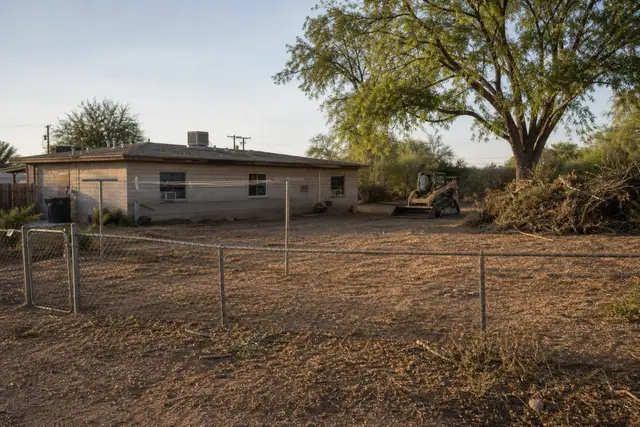
Tres Rios Land Clearing connects Cashion property owners with a local land clearing contractor for clearing, mulching, and brush work across the Cashion area.
Cashion is Avondale's historic southern neighborhood — a former farm-town community with its own post office since 1911, annexed into the city decades ago but still carrying its own name, its own grid between Buckeye Road and Durango Street, and the deep residential lots of its agricultural past. Those lots are the clearing story here: properties that run back a hundred feet or more past the house, where decades of mesquite volunteers, junk brush, and accumulated stuff have claimed the rear half.
The work is reclamation at household scale. A back lot cleared of its thicket returns real usable ground — for a shop, a garden, parking for the work truck, or simply a yard the family can see the back fence of again. The typical package: woody volunteers grubbed at the crown so they stay gone, keeper shade trees preserved and cleaned up, mixed debris sorted and hauled, and the ground left rough-raked with its surface intact so it does not become a dust patch.
Cashion's position matters too. The neighborhood sits close to the Salt-Gila confluence country, and properties toward the river pick up the bottomland problems — tamarisk volunteers, storm-carried debris, and the heavier weed pressure of ground with a shallow water table. It is the same clearing playbook as the rest of the river reach, applied at neighborhood-lot scale.
Reclaiming the deep lot
The deep Cashion lot rewards a specific sequence: sort before machines. A rear parcel that has collected years of brush usually also holds material worth keeping, scrap worth separating, and genuine junk — and an hour of walk-through sorting saves a day of grapple confusion. Then the vegetation pass runs front-to-back, keepers flagged, volunteers grubbed, and the haul staged so the family driveway is blocked for hours, not days. The City of Avondale governs what needs permits when a structure or right-of-way is involved; plain vegetation work on your own lot needs none.
Shade is currency on these blocks, so mature trees get individual verdicts rather than a blanket clear. An old cottonwood or a healthy mesquite earns its keep in summer; the half-dead athel leaning at the shed does not. The extension service's tree guidance is the neutral reference when a keeper-or-goner call is genuinely close.
River-edge realities south of Durango
Ground sloping toward the rivers carries water history in it — old flood-irrigation grades, occasional storm flow paths, and the seed rain of the tamarisk stands along the channels. Lots on that edge benefit from the invasive-removal discipline: tamarisk volunteers pulled young, before their root crowns turn removal into excavation, with the federal saltcedar profile explaining exactly why early beats late on this species.
The confluence itself is also the neighborhood's quiet amenity: the restored wetlands of the Tres Rios project lie just downstream, proof of what the bottomland looks like when the invasives lose. A cleaned lot on the Cashion edge participates in the same story at parcel scale — less tamarisk seed, less debris for the next storm to move, more ground doing what its owner actually wants.
Good to know
What does it cost to clear the back half of a deep lot?
Typical Cashion back-lot reclamations run from around a thousand dollars for brush-only work into the low-to-mid four figures when tree removal and heavy mixed-debris hauling join the scope. Sorting salvage from junk at the walk-through keeps the disposal line honest.
Can you keep our shade trees and clear everything else?
That is the standard spec here. Keepers get flagged and their canopies cleaned; everything else is grubbed at the root crown so the thicket does not restart. The difference shows the following summer — shade kept, jungle gone.
Do you haul old junk and scrap along with the brush?
Yes — mixed loads are the Cashion norm. Metal is separated for scrap, green waste and trash go to their respective facilities, and anything the family wants kept is staged aside before machine work starts.
Will the cleared ground turn into a dust problem?
Not if it is finished right: vegetation cut and grubbed with the soil crust left intact, rough-raked rather than bladed bare. A lot cleared that way holds its surface through wind season; a scraped one does not, which is why blading is reserved for ground about to be built on.
We are near the river and keep getting tamarisk volunteers. Can that stop?
It can be managed to nearly nothing. Pull the volunteers young — roots and all, which is quick work at seedling size — and repeat a brief check yearly. The seed source is the river corridor, so vigilance is the realistic goal, and it is a cheap one.