 Tres Rios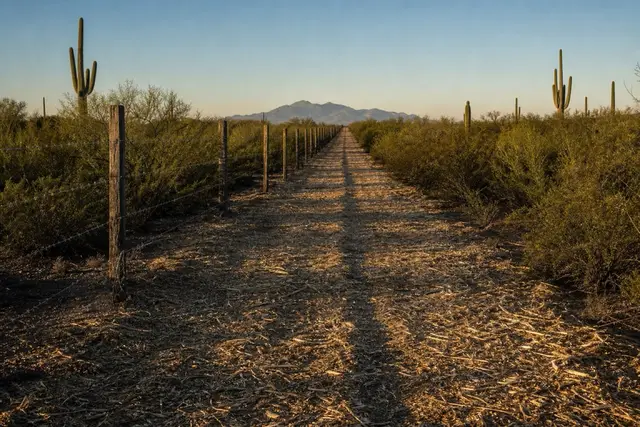
Tres Rios Land Clearing connects Avondale property owners with a local land clearing contractor for fence line clearing in Avondale and the surrounding West Valley communities.
A fence line is where clearing problems concentrate. Tumbleweed stacks against wire until the wind load flattens posts; volunteer mesquite grows through field fence and welds itself into the mesh; and on the horse properties around Rainbow Valley, Waddell, and Laveen, a brushy line hides the broken strand that lets an animal out onto a dark road. Fence-line clearing runs a machine down the corridor — both sides where access allows — and gives you back a line you can see, walk, and fix.
New fence builds are the other half of the work. Fence contractors price better and build straighter when the corridor is cleared and grubbed ahead of them: an eight-to-ten-foot band cut to grade, root crowns out so nothing lifts the new fence later, and old wire, posts, and concrete footings hauled off. On the legacy farm parcels west of Avondale that often includes pulling decades of buried fencing archaeology — three generations of wire in the same line is a normal find out here.
Maintenance math favors the corridor. A cleared line mowed annually costs a fraction of a rescue job on a line the desert has owned for ten years, and it keeps every downstream expense smaller: posts last longer without brush holding moisture against them, wire stays visible for repair before failure, and the fire-fuel ribbon that a brushy fence line becomes in June simply is not there.
The tumbleweed-and-wind problem on West Valley lines
Russian thistle cures, snaps, and travels on exactly the winds the Phoenix forecast office warns about — spring frontal passages and summer monsoon outflows. A perimeter fence is a tumbleweed net, and a loaded net in a sixty-mile-an-hour outflow takes a mechanical beating: bent T-posts, stretched wire, and in the worst cases whole panels laid over. Owners on open ground west of the Agua Fria fight this yearly.
The mitigation is boring and effective: clear the line before spring, so there is no standing dead crop on your side to break loose, and mow the approach so wind-blown material rolls along the fence to a collection corner instead of pinning against the full length. Where the neighboring parcel is the source, a cleared strip on your side still halves the load — and Maricopa County's nuisance-weed process exists for the parcels nobody maintains.
Clearing for new fence: what the fence builder wishes you knew
Post holes and roots do not negotiate. A mesquite root crown left in the line means either a crooked dogleg or an auger fight, and green brush crowding the corridor slows a fence crew to hand-tool pace. The prep spec that saves real money: corridor cut and grubbed to grade, spoils windrowed outside the string line, and the crossing points over any wash armored or left for the builder's engineered solution rather than bladed flat — bank vegetation on desert washes holds the very soil the corner post needs, a point extension range guidance makes repeatedly.
Property-line diplomacy is cheaper than surveying twice. Clearing exposes the actual line, which occasionally surprises owners who inherited a fence built by eye in 1975. When the corridor matters — sale, split, or new construction — running the clear a foot inside your surveyed line until pins are confirmed keeps goodwill with the neighbors and keeps the city's records the only authority anyone needs to argue from.
Further reading
Good to know
What does fence line clearing cost?
Phoenix-area fence-line jobs commonly land around $1,600, but the honest unit is the linear foot at a given brush density. A quarter-mile of light tumbleweed line clears cheap; the same distance of grown-through mesquite with old-wire extraction is a different quote. Free walk-throughs price the actual corridor.
Can you clear along an existing fence without wrecking it?
Yes — that is the craft. Mulcher and brush-cutter heads work parallel to the wire, hand cutting takes the growth inside the mesh, and grubbing happens far enough off the posts to leave footings undisturbed. Where a tree has genuinely absorbed the fence, that section is flagged for repair honestly instead of hidden.
What width should a fence corridor be cut to?
Eight to ten feet for a build corridor; six is a workable maintenance width; livestock lines do best with a mowed strip wide enough to drive, which turns every future repair into a tailgate job. Narrower than that and you are paying mobilization for a corridor you cannot use.
Do you take out the old wire and posts too?
Yes, and say so at the quote if you know layers are buried — legacy farm lines around the West Valley often carry multiple generations of wire in the same run. Old steel is separated for scrap, concrete footings get popped with the excavator, and the corridor is left magnet-swept where horses will live.
My neighbor's brush is the problem. What are my options?
Clear your side wide enough to protect the fence, and use the county's weed-nuisance process for a parcel that is genuinely abandoned. A cleared strip on one side alone dramatically cuts wind-load and fire exposure — and it establishes plainly whose vegetation is whose, which tends to move the neighborly conversation along.