 Tres Rios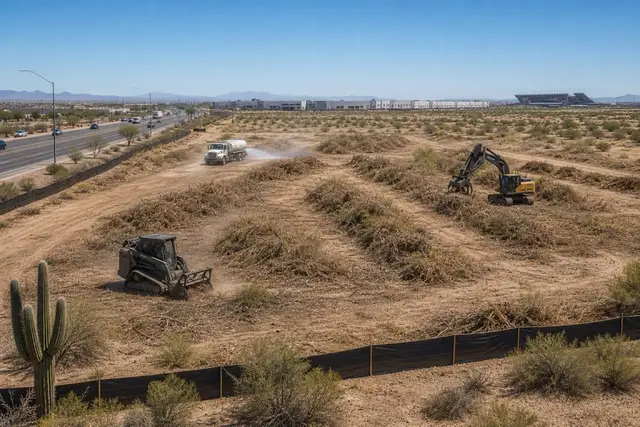
Tres Rios Land Clearing connects Avondale property owners with a local land clearing contractor for commercial site clearing in Avondale and the surrounding West Valley communities.
The southwest Valley is one of the country's busiest industrial development corridors — distribution, manufacturing, and retail pads going in along I-10, Loop 101, and the arterials around Avondale, Goodyear, and Tolleson, on ground that was creosote flat or fallow farmland eighteen months earlier. Commercial site clearing is the first trade on that ground: every plant off the parcel, root systems grubbed, debris processed or hauled, and the site handed to the mass-grading contractor clean, on schedule, and with its paperwork in order.
Paperwork is half the trade at this scale. Disturb multiple acres in this county and a dust-control permit with an approved plan comes first, water equipment on site every operating day, track-out control at every exit, and named, trained responsible parties. Storm-water rules bring silt fence and stabilized entrances even in a place where it rains sixty minutes a month, and the state native-plant clock — notification before protected species come off undeveloped land — has sunk more naive schedules than any machine breakdown ever has.
Commercial invoices reflect commercial scope: metro clearing for multi-acre sites typically runs thousands of dollars per acre depending on vegetation density and disposal method, and a one-to-three-acre pad clearing commonly lands in the five-figure range. What the general contractor is actually buying is schedule certainty — a clearing sub who mobilizes when promised, coordinates dust and SWPPP obligations without hand-holding, and leaves nothing in the ground for the grader to find.
The compliance stack on a West Valley commercial clear
Three programs govern the ground. The county's air rules put multi-acre soil disturbance under a dust-control permit with plan, water, track-out, and training obligations that inspectors actively enforce across the metro nonattainment area. Storm-water rules add perimeter controls and stabilized entrances. And Arizona's native plant law runs on its own calendar: protected species on undeveloped land require state notification ahead of destruction, with salvage rights in play — the extension summary is the fastest orientation for out-of-state developers.
Sequencing keeps all three cheap. The native-plant survey and notification go in during due diligence, the dust plan is approved before mobilization, and perimeter controls go up the morning clearing starts. Handled in that order, compliance is days of lead time and modest line items; handled reactively, any one of the three can idle a spread of iron at four figures a day.
From creosote flat to grading-ready: what the handoff includes
A commercial clear is judged by what the next contractor does not find. The spec that survives audits: vegetation grubbed with root systems out — not sheared at grade where buried crowns become soft spots under pavement — organics and debris segregated and hauled to appropriate facilities, on-site grinding where the project can reuse mulch for interim stabilization, and any discovered surprises (old foundations, buried irrigation mains from the parcel's farming decades, the occasional abandoned well) documented and priced as changes rather than buried again. Municipal development standards from the City of Avondale and its neighbors define the approvals the clearing phase feeds into.
Weather windows are the schedule wildcard. Monsoon season brings the dust-event shutdowns and washout risks the Phoenix NWS forecasts daily from mid-June through September, so experienced teams bias big clearing pushes toward fall-through-spring and carry contingency days when a summer schedule cannot move. It is cheaper to plan around the desert's one violent season than to fight it with change orders.
Further reading
Good to know
What does commercial site clearing cost per acre?
West Valley multi-acre clearing typically prices in the thousands per acre, with density, disposal method, and haul distance the drivers; a one-to-three-acre commercial pad commonly lands in five figures all-in. Plan-based quotes with unit prices for discovered conditions are standard at this scale.
How fast can a multi-acre site be cleared?
With the right spread — mulcher, excavators, haul capacity — production of an acre-plus per machine-day on typical desert vegetation is realistic, so most pad-scale sites clear in days once permits are in hand. The long pole is almost never the machinery; it is the dust permit and native-plant clock, which is why those start early.
Who handles the dust permit and SWPPP controls?
The clearing contractor carries the dust obligations for its operations under the project's permit — water, track-out, trained personnel — and installs or works within the SWPPP perimeter controls per the project plan. Confirm in the subcontract who owns the permit itself; on most projects the GC or owner holds it and subs comply under it.
What about protected plants on a development parcel?
They are inventoried during due diligence, the state notification is filed for what must come off, and salvageable specimens can be claimed for relocation — saguaros in particular are relocation candidates under permit, never casual removals. Building the 20–60 day state window into the pre-construction schedule costs nothing; discovering it late costs the schedule.
Can cleared material be reused on site?
Frequently, and it saves money twice. Ground vegetation becomes interim stabilization mulch that offsets water-truck hours on dust control, and clean soil from grubbing can feed the mass-grading balance. The disposal plan in the quote spells out what leaves, what stays, and what each choice does to the number.