 Tres Rios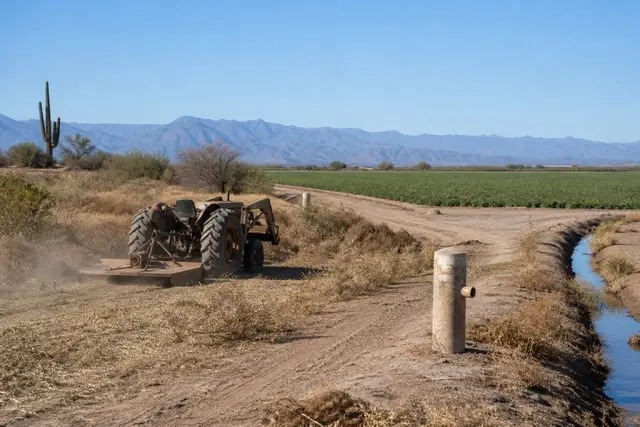
Tres Rios Land Clearing connects Liberty property owners with a local land clearing contractor for clearing, mulching, and brush work across the Liberty area.
Liberty is one of the oldest farming settlements in the southwest Valley — a crossroads community at Jackrabbit Trail and Baseline Road that has carried its name since 1901 and still functions as working farm country, sitting as an unincorporated county island inside Buckeye's corporate boundary. The parcels out here are field-scale, not lot-scale: flood-irrigated ground, ditch networks, and the long fence runs that come with real acreage.
The clearing work matches the landscape. Fallow fields need brush-hogging before the tumbleweed crop loads every fence between here and the river; ditch banks need salt cedar and volunteer mesquite pulled before root intrusion wrecks the concrete; and the field corners that stopped getting water a decade ago need genuine reclamation — grubbing, not mowing — to come back into production. Horse and livestock owners add the usual corridor work: turnout edges, fence lines wide enough to drive, and access lanes kept passable.
Machinery scale is the practical advantage of quoting Liberty work honestly. Jobs here justify field equipment — a proper tractor and brush hog, a mulcher that can walk a half-mile fence line without remobilizing — and per-acre economics beat the subdivision-lot rates that metro guides quote. A walk of the actual ground, with the ditch system and the acreage in view, produces the real number.
Working ground that still irrigates
Liberty's value is its water infrastructure: laser-graded borders and lined ditches built across a century of cotton and alfalfa. Clearing work on these parcels protects that infrastructure or wastes it — a mulched field with intact borders can take water again next season, while a carelessly bladed one needs re-leveling before a single row gets wet. The University of Arizona Cooperative Extension remains the standing resource for small-acreage irrigators bringing legacy fields back into rotation.
South of the community, the Gila's bottomland carries the tamarisk problem this whole stretch of river shares. Parcels that run to the river benefit from the same invasive-removal logic as anywhere on the reach: extraction by the roots, disposal off site, and a recheck after the next flow event, with the Flood Control District's mapping consulted before any bank work near the floodway.
Big-sky parcels, big-wind fences
Open ground west of the Agua Fria takes wind with nothing to slow it, and Liberty's long perimeter fences collect the spring tumbleweed harvest for every unmown parcel upwind. The economical rhythm is a pre-summer mow of your own ground plus a cleared corridor along the wire, which cuts both the wind load and the June fire exposure that the Phoenix forecast office's red-flag days turn serious.
Liberty's identity as farm country is durable — the community anchors the Liberty Elementary School District and remains a name on the land even as Buckeye's growth surrounds it, a pattern Maricopa County's West Valley growth numbers make vivid decade after decade. For owners, that means clearing decisions here are stewardship decisions: ground kept clean and irrigable holds value that subdivided ground nearby has already cashed out.
Further reading
Good to know
Do you handle field-scale mowing near Liberty?
Yes — this is exactly the territory for tractor-and-brush-hog work rather than skid-steer-only scope. Multi-acre mows, fallow-field knockdowns, and seasonal maintenance cuts all price by the acre with equipment matched to the ground.
What does it cost to clear a fallow field by the river?
Mowing a weed mat runs cheap per acre; pulling established mesquite or tamarisk out of ditch banks and field corners is priced from a walk of the ground. Most Liberty-area reclamations land in the low-to-mid four figures depending on woody density and disposal.
Can you clear along the irrigation ditches without damaging them?
That is the point of doing it right: root masses get extracted away from the lining, spoil is kept out of the channel, and the ditch is left cleaner than found. Joint intrusion gets flagged during the work so small repairs happen before they become failures.
Is Liberty inside Buckeye for permit purposes?
Liberty is an unincorporated county island within Buckeye's corporate boundary, so jurisdiction can genuinely vary by parcel and activity. The contractor confirms whether county or city rules govern your specific job — dust control applies either way once enough soil is disturbed.
How soon before summer should fields be mowed?
Late spring — after the winter annuals finish and before monsoon winds start moving dead material. That single well-timed cut handles the tumbleweed, the fire fuel, and the fence-load problem in one mobilization.